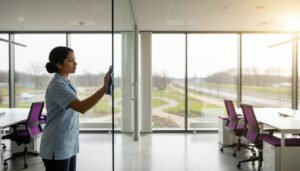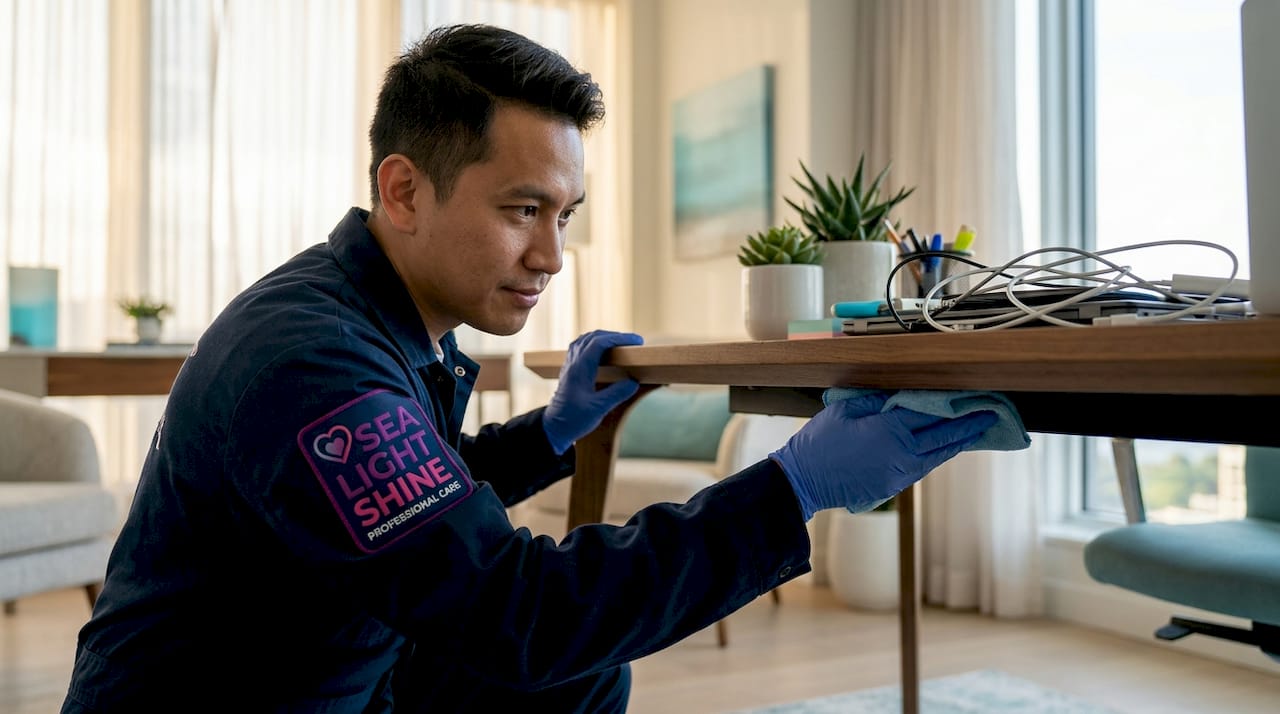
Routine cleaning keeps an office looking presentable, but it rarely addresses the bacteria, allergens, and grime building up in places nobody thinks to check. Keyboards harbour more bacteria than a toilet seat, ventilation grilles circulate dust across entire floors, and the undersides of desks collect years of neglected debris. For office managers and business owners across East Anglia, the gap between a surface-level tidy and a genuinely hygienic workspace can directly affect staff health, morale, and productivity. This article breaks down exactly which deep clean tasks matter most, why they matter, and how to plan them effectively.
Table of Contents
- What makes an office deep clean ‘deep’? Criteria explained
- High-impact deep clean office tasks: room-by-room breakdown
- Comparison of deep clean vs regular clean: What’s really different?
- Situational pro tips: overlooked office deep clean tasks and when to schedule them
- What most checklists get wrong about deep cleaning offices
- How professional deep cleaning supports a healthier workplace
- Frequently asked questions
Key Takeaways
| Point | Details |
|---|---|
| Deep cleaning targets hidden areas | Office deep cleaning goes beneath surfaces, dealing with neglected or hard-to-reach spots often missed by daily routines. |
| Key tasks boost hygiene and morale | Sanitising behind furniture, inside appliances, and on window frames reduces illness and improves the work environment. |
| Task scheduling is crucial | Regular deep cleans, alongside situational checks, address specific workspace risks to ensure consistent cleanliness. |
| Checklist flexibility matters | Site-specific adaptations and expert insight are essential to cover all high-impact cleaning needs in busy offices. |
What makes an office deep clean ‘deep’? Criteria explained
Now that you know what’s at stake, let’s define what sets a deep office clean apart from everyday routines.
A standard clean handles what you can see: wiping desks, emptying bins, vacuuming carpets. A deep clean goes further. It targets the spaces that accumulate grime over weeks and months precisely because they’re awkward to reach or easy to forget. Think of it as resetting the hygiene baseline rather than maintaining it.
Deep cleaning tasks often go beyond visible surfaces to include hidden, hard-to-reach, or high-touch points. That distinction is what separates a genuinely thorough clean from one that simply looks good on the day.
Key criteria that define a true deep clean include:
- Hidden surfaces: Behind filing cabinets, under desks, inside cupboards, and above ceiling-height shelving.
- High-touch points: Light switches, door handles, keyboard trays, and shared equipment controls that daily cleaning often skips.
- Ventilation and air quality: Dusting grilles, cleaning air conditioning filters, and removing dust from fan units.
- Fabric and upholstery: Steam cleaning or sanitising office chairs, sofas, and soft furnishings that absorb odours and allergens.
- Appliance interiors: Fridges, microwaves, dishwashers, and kettles in kitchen areas.
- Structural details: Skirting boards, window frame tracks, blinds, and light fittings.
These broad cleaning activities are rarely included in a daily or even weekly cleaning schedule, yet they have a measurable impact on air quality and overall hygiene. Our detailed office cleaning checklist covers many of these points in practical depth if you want a ready-to-use reference.
Pro Tip: Before scheduling a deep clean, walk through each room and physically note every surface that hasn’t been touched in the past month. You’ll almost certainly find more than you expected.
High-impact deep clean office tasks: room-by-room breakdown
Understanding core criteria, let’s move into practical examples segmented by office space type.
Different areas of an office carry different hygiene risks. A desk zone has different concerns from a shared kitchen or a washroom. Mapping tasks to specific areas helps you allocate time, resource, and specialist equipment more accurately.
Edge cases like under or behind furniture, vents, blinds, and appliances are repeatedly noted in professional checklists as the most commonly skipped items. The table below gives you a clear overview of which tasks belong to which area.
| Office area | Top deep clean tasks |
|---|---|
| Workstations and desks | Sanitise desk undersides, clean keyboard and mouse thoroughly, wipe monitor backs and cable runs |
| Reception and entrance | Deep clean door handles and push plates, sanitise seating, clean skirting boards and light fittings |
| Meeting rooms | Steam clean upholstered chairs, wipe projector lenses, clean whiteboard tracks and blind slats |
| Kitchen and break room | Defrost and sanitise fridge interior, clean microwave cavity, descale kettle, wipe cupboard interiors |
| Washrooms | Descale taps and showerheads, sanitise behind toilets, clean grout lines, wipe extractor fan covers |
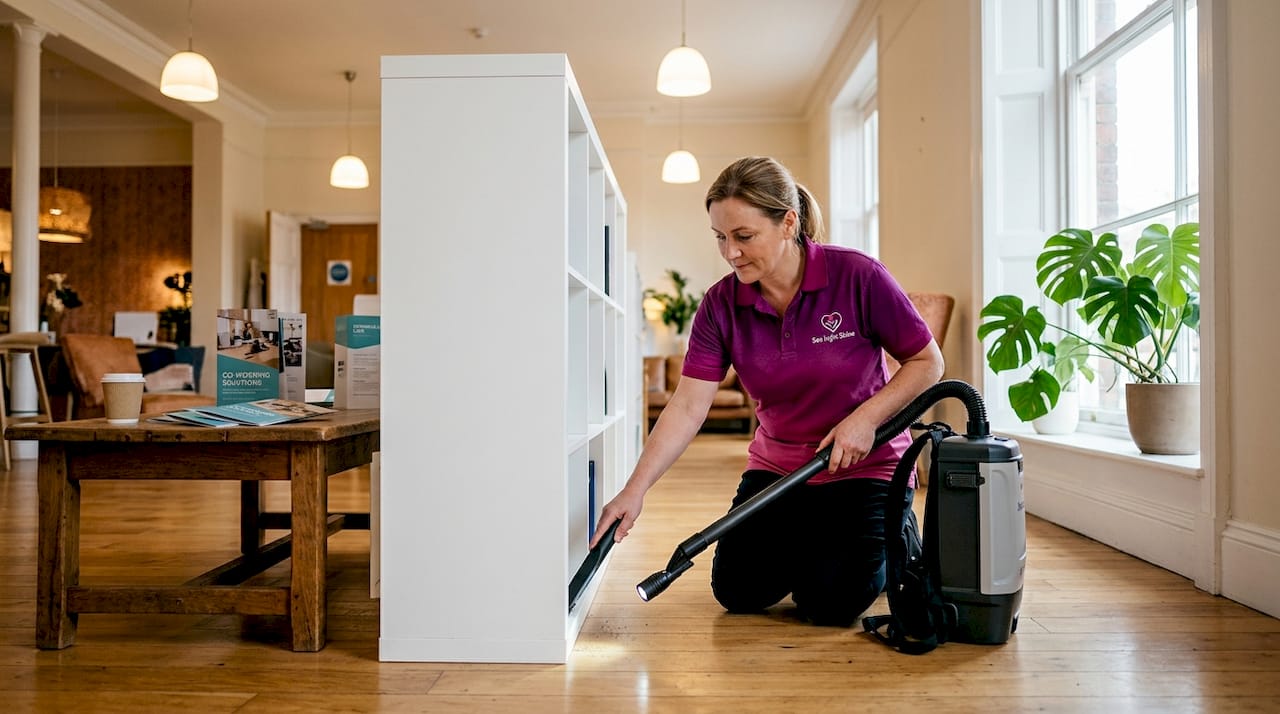
| Storage and server rooms | Vacuum behind shelving units, dust server equipment exteriors, clean floor corners and skirting |
This room-by-room approach also makes it easier to assign tasks to specific team members or contractors without overlap or confusion. Our daily cleaning guidance explains how to layer these deeper tasks on top of a consistent routine.
Tasks that most often get missed include:
- Blind slats: Dust accumulates heavily here and is redistributed into the air every time blinds are adjusted.
- Fridge door seals: Mould grows in the rubber gaskets and is rarely noticed until it becomes a visible problem.
- Desk cable runs: Tangled cables trap dust and debris, making the area beneath workstations a hidden hygiene risk.
- Inside window frame tracks: These collect dead insects, moisture, and grime that standard window cleaning never addresses.
- Chair base castors: Carpet fibres and debris wrap around castors, which then spread dirt as chairs move around.
A comprehensive move-out cleaning checklist from a property context highlights many of these same overlooked areas, underlining how universal these blind spots are across different types of spaces.
Comparison of deep clean vs regular clean: What’s really different?
To clarify the added value of deep cleaning, let’s compare it directly with a regular cleaning routine.
The distinction is not just about effort. It’s about scope, frequency, and the types of hygiene risks each approach addresses. Deep cleaning covers hidden and less obvious areas, while regular routines focus on visible and high-traffic surfaces. That difference has real consequences for staff health and workplace satisfaction.
| Task category | Regular clean | Deep clean |
|---|---|---|
| Desk surfaces | Wiped daily | Undersides, edges, and cable areas cleaned thoroughly |
| Floors | Vacuumed or mopped | Edges, corners, and under furniture addressed |
| Kitchen appliances | Exterior wiped | Interiors sanitised, seals cleaned, descaling done |
| Washrooms | Surfaces cleaned | Grout, extractor fans, and behind fixtures addressed |
| Air quality | Not typically addressed | Vents, grilles, and filters dusted or replaced |
| Upholstery | Not included | Steam cleaned or sanitised |
| Frequency | Daily or weekly | Every 3 to 6 months, or situationally |
The health impact of this distinction is significant. Studies suggest that a cleaner workplace environment can reduce short-term sickness absences by a meaningful margin, with some estimates pointing to a reduction of up to 46% in the spread of common viruses when high-touch surfaces are regularly disinfected. For East Anglia businesses operating with lean teams, even a small reduction in sick days represents a genuine financial return.
Our deep vs regular clean comparison explores this distinction in even more detail, including how to decide which approach your space needs right now. You might also find a rental property cleaning checklist useful for understanding the standard of cleanliness professional operators expect, which maps closely to what office managers should be aiming for.
The key takeaway: Regular cleaning maintains appearance. Deep cleaning protects health. Both are necessary, but they serve different purposes and should never be confused for one another.
Situational pro tips: overlooked office deep clean tasks and when to schedule them
Beyond core and comparative tasks, it’s easy to miss certain critical deep clean jobs. Here’s how to catch and plan for them.
Timing a deep clean strategically makes a significant difference to both its effectiveness and the disruption it causes. The five most overlooked tasks in office deep cleaning, along with the rationale for each, are:
- Ventilation grille cleaning: Dust and particulate matter build up inside grilles and are then circulated throughout the office. This directly affects air quality and can trigger allergies or respiratory irritation in staff. Clean these every quarter at minimum.
- IT equipment detailing: Keyboards, mice, telephone handsets, and shared monitors are among the highest-touch surfaces in any office. A deep clean should include careful sanitisation with appropriate products that won’t damage electronics.
- Office blind deep cleaning: Tasks such as behind heavy furniture, inside window frames, and deep cleaning of office blinds are often missed entirely. Blind slats should be wiped individually or removed and soaked, depending on material.
- Behind and beneath office storage: Filing cabinets and storage units are rarely moved during routine cleaning. The floor and wall surfaces behind them accumulate significant dust, debris, and occasionally moisture. Cleaning behind office storage is one of the most impactful but least performed tasks in any office.
- Upholstered furniture sanitising: Fabric chairs and sofas absorb sweat, skin cells, and food particles over time. Without periodic steam cleaning or specialist treatment, they become a source of odour and bacterial growth that no amount of surface wiping will address.
“The most effective deep cleans we carry out are the ones where the client has thought carefully about timing. Pre-audit cleans, end-of-quarter resets, and post-refurbishment cleans consistently deliver the best results because the space is either unoccupied or at low capacity. Scheduling around your team’s calendar is just as important as the cleaning itself.”
Pro Tip: Plan your deep clean around a bank holiday weekend or a period when staff are working remotely. This gives the cleaning team uninterrupted access and allows surfaces, particularly freshly sanitised upholstery and floors, to dry and air properly before staff return.
For a thorough overview of what a professional restorative clean involves from start to finish, our restorative deep cleaning steps guide is worth reading before you book.
What most checklists get wrong about deep cleaning offices
Here is the nuanced reality office managers rarely hear.
Most deep cleaning checklists are written as universal templates. That’s both their strength and their biggest weakness. A checklist designed for a generic open-plan office will miss the specific challenges of a law firm with dense filing storage, a design studio with specialist equipment, or a medical practice with infection control requirements. The checklist is a starting point. It is never a substitute for a site-specific review.
In our experience working with businesses across East Anglia, the tasks that get missed most consistently are not the ones that are hard to do. They’re the ones that are hard to access because furniture or workflow makes them inconvenient. Nobody moves the six-drawer filing cabinet to clean behind it. Nobody removes the monitor arm to wipe the wall surface beneath it. These are the areas where dust, allergens, and occasionally mould quietly accumulate over months.
There’s also a tendency to overlook air quality as a cleaning concern. Most checklists focus on surfaces. But the air in an office carries a significant proportion of the allergens and pathogens that affect staff health. Addressing ventilation grilles, air conditioning filters, and even the dust on top of tall furniture contributes meaningfully to the air quality your team breathes every day.
IT equipment detailing is another area where checklists fall short. A keyboard cleaned with a generic surface wipe is not the same as one that has been properly sanitised with appropriate products. The same applies to telephone handsets, shared tablets, and touchscreen displays.
Our recommendation: always conduct a pre-clean walk-through with your cleaning provider before the deep clean begins. Walk every room together, identify access challenges, flag specialist equipment, and agree on task priorities. This takes 20 minutes and dramatically improves the outcome. Our commercial contractor insight resource explains what to look for when choosing a professional team who will actually do this with you rather than simply arriving with a standard checklist.
How professional deep cleaning supports a healthier workplace
If you need support turning these checklists into action, consider how professional teams can take the burden off your staff.
For office managers across East Anglia, the challenge is rarely knowing what needs doing. It’s finding the time, the right equipment, and a reliable team to actually do it. A professional deep clean is not just a one-off tidy. It’s an investment in your team’s health, your workplace’s reputation, and the long-term condition of your fixtures and fittings.
At Sea Light Shine, we work with businesses across East Anglia to deliver deep cleaning that goes beyond the surface. Our teams are trained to follow site-specific checklists, conduct pre-clean walk-throughs, and tackle the areas that standard cleaning routinely misses. Whether you need a quarterly office deep clean or a one-off reset after a refurbishment, our Ipswich commercial cleaning service is built around reliability, punctuality, and genuine attention to detail. We also offer specialist guidance for businesses navigating tenancy transitions through our end of tenancy cleaning insight. Get in touch to discuss what your office actually needs.
Frequently asked questions
How often should an office undergo a deep clean?
Most offices benefit from a professional deep clean every 3 to 6 months, with high-traffic areas requiring more frequent attention. Expert checklists recommend quarterly to biannual deep cleans to maintain consistent hygiene standards.
What’s the difference between deep cleaning and daily office cleaning?
Deep cleaning targets hidden, hard-to-reach, and high-touch points, while daily cleaning covers visible surfaces and regular upkeep. Deep cleaning tasks cover more comprehensive, less frequent responsibilities that a daily routine simply cannot address.
Which office areas are most often missed during deep cleans?
Typically, areas behind large furniture, inside window frame tracks, and ventilation grilles are neglected most often. Areas behind and under equipment and furniture are listed consistently as common oversights in professional cleaning audits.
Why is professional deep cleaning important for offices?
It helps eliminate hidden germs and allergens, improving workplace health and comfort for all staff. Professional deep cleaning addresses both hygiene and staff satisfaction in ways that in-house routines rarely achieve on their own.