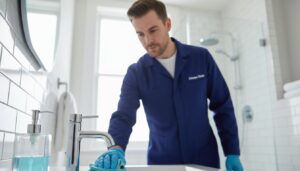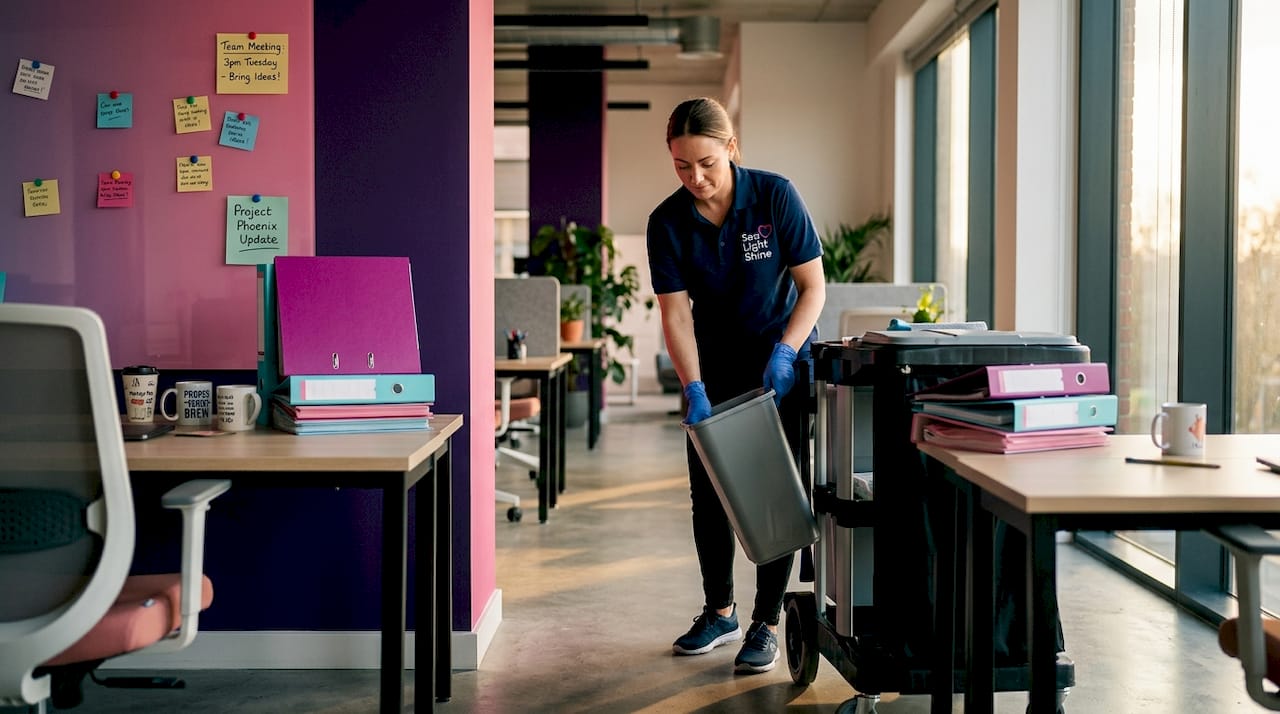
Most business owners in East Anglia assume that if their premises look clean, they are clean. That assumption is costing them money, staff productivity, and in some cases, their regulatory standing. A quick mop and a wipe-down might satisfy a casual glance, but it leaves behind invisible hazards: cross-contamination, airborne allergens, and compliance gaps that inspectors and insurers will not overlook. Professional cleaning is not a luxury for large corporations. It is a practical, measurable tool for protecting your business, your people, and your property.
Table of Contents
- Beyond surface shine: The true value of professional cleaning
- How professional cleaners protect health and maintain compliance
- Operational efficiency: Why cleaning standards matter for your bottom line
- Air quality and facility performance: The hidden impact of cleaning
- Consistency at scale: How professional vendors deliver reliability
- Why professional cleaning is a silent business asset — our perspective
- Find a trusted cleaning partner in East Anglia
- Frequently asked questions
Key Takeaways
| Point | Details |
|---|---|
| True cleaning is invisible | Professional standards address risks you can’t see, not just cosmetic appearance. |
| Health and compliance gains | Expert cleaners help prevent illness, avoid compliance problems, and protect your liability. |
| Operational efficiency boost | Standardised cleaning unlocks greater productivity and lower downtime for your business. |
| Building health matters | Facility performance and air quality depend on thorough, routine cleaning practices. |
| Reliability at every site | Professional vendors guarantee consistent standards for single and multi-site operations. |
Beyond surface shine: The true value of professional cleaning
There is a persistent myth in business that cleaning is a simple, low-skill task anyone can manage. The reality is that visual tidiness and genuine hygiene are two entirely different things. A surface can look spotless and still harbour bacteria, allergens, or chemical residues that pose real risks to staff and visitors.
This gap between appearance and actual cleanliness is where businesses get into trouble. In environments like food preparation kitchens, healthcare waiting rooms, or busy offices with shared equipment, the stakes are especially high. Cross-contamination from improperly cleaned surfaces is a leading cause of workplace illness outbreaks. And when an outbreak happens, the cost is not just a few sick days. It is lost productivity, potential legal liability, and in regulated sectors, the risk of a failed inspection.
Consider what happens during a local authority food hygiene inspection. An inspector does not just look at whether the floor is swept. They check whether cleaning schedules are documented, whether products are used correctly, and whether staff understand the difference between sanitising and disinfecting. An untrained cleaner, however well-intentioned, rarely meets those standards consistently.
Professional commercial cleaning helps businesses maintain genuine hygiene by using trained methods, correct product concentrations, and structured routines that go far beyond what a quick in-house clean achieves. As research confirms, illness transmission risk is materially reduced when professional standards are applied, not just in healthcare, but across all sectors.
“Professional commercial cleaning helps businesses maintain health and safety outcomes by reducing illness transmission risk and supporting regulatory preparedness.” — ISSA Healthcare Cleaning Research
Key risks that visual cleaning alone fails to address:
- Cross-contamination from shared cloths, mop heads, and surfaces used across different zones
- Allergen accumulation in carpets, upholstery, and ventilation grilles
- Chemical misuse that leaves residues or fails to achieve the required contact time for disinfection
- Documentation gaps that leave businesses exposed during inspections
- Inconsistent frequency that allows biofilm and grime to build up in hard-to-reach areas
How professional cleaners protect health and maintain compliance
Once you accept that visual checks are incomplete, the next question is what professional cleaning actually delivers in terms of health outcomes and regulatory compliance. The answer is significant.
Trained cleaners follow standard operating procedures (SOPs) that are designed to break the chain of infection. They use colour-coded equipment to prevent cross-contamination between zones, apply products at the correct dilution and dwell time, and document their work. That documentation is not bureaucracy for its own sake. It is evidence that your business is meeting its duty of care, and it is exactly what inspectors want to see.
For sectors with strict compliance requirements, such as care homes, nurseries, dental practices, and food businesses, the consequences of getting this wrong are severe. A failed inspection can result in closure, fines, or reputational damage that takes years to recover from. Professional cleaners who understand sector-specific requirements, including nursery and clinic cleaning best practices, provide a level of assurance that an ad hoc approach simply cannot match.
The impact on sick days is equally compelling. Workplaces with consistent professional cleaning programmes see fewer illness-related absences. When high-touch surfaces like door handles, keyboards, and shared equipment are cleaned and disinfected on a proper schedule, the illness transmission risk drops noticeably. For a small East Anglian business with a tight team, even one avoided outbreak can justify the annual cost of professional cleaning.
Pro Tip: Before your next compliance inspection, ask your cleaning partner to provide a copy of their SOPs and cleaning schedules. Having this documentation ready demonstrates proactive management and can significantly smooth the inspection process.
| Factor | In-house cleaning | Professional cleaning |
|---|---|---|
| Training level | Minimal, informal | Sector-specific, certified |
| Equipment quality | Basic, often shared | Specialist, colour-coded |
| Documentation | Rarely maintained | Structured records kept |
| Compliance readiness | Low | High |
| Consistency | Variable | Standardised and auditable |
| Infection control knowledge | Limited | Trained and updated regularly |
Operational efficiency: Why cleaning standards matter for your bottom line
Compliance and health are compelling reasons to invest in professional cleaning, but the operational efficiency argument is equally strong. Many business owners do not realise how much time, money, and management energy is wasted when cleaning is handled informally.
When cleaning tasks are assigned to staff as an afterthought, errors multiply. Surfaces get missed. Products run out. Equipment is misused and breaks down. Staff spend time on tasks outside their core role, which reduces their productivity and often their morale. Worse, there is no accountability. If something is not cleaned properly, it is difficult to identify where the process failed.
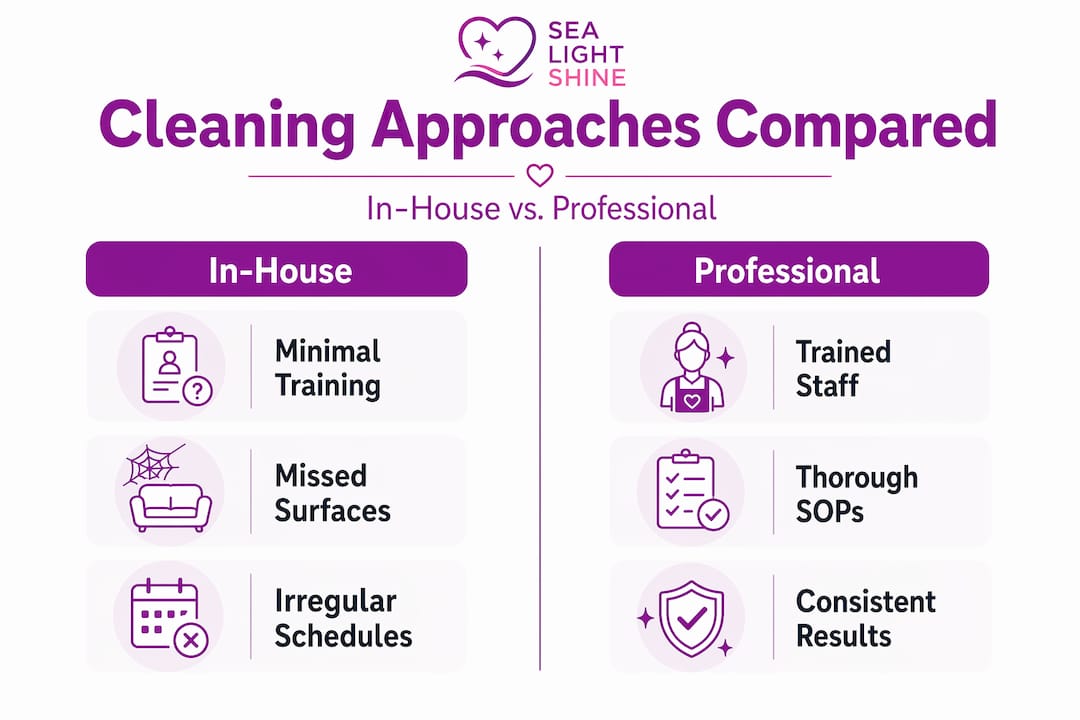
Professional cleaners eliminate these inefficiencies by standardising every task. As industry research confirms, standardised work instructions improve task completion speed, reduce training downtime, and prevent duplicated or missed steps. For a business managing multiple properties or a busy commercial premises, this translates directly into cost savings and fewer disruptions.
The table below illustrates how standardised professional cleaning compares to informal arrangements across key operational metrics:
| Metric | Informal/in-house | Professional with SOPs |
|---|---|---|
| Average training time per cleaner | 3 to 5 hours, repeated | 1 to 2 hours onboarding |
| Task completion accuracy | 60 to 70% | 90 to 95% |
| Equipment downtime due to misuse | Frequent | Rare |
| Management oversight required | High | Low |
| Scalability as business grows | Difficult | Straightforward |
Establishing office cleaning routines that run like clockwork also protects workplace cleaning consistency across your entire operation, which matters enormously when you are managing staff expectations and client impressions simultaneously.
Here is how professional cleaners maintain operational efficiency on a day-to-day basis:
- Conduct a site audit before starting to map all areas, frequencies, and specialist requirements
- Develop a written cleaning schedule with assigned tasks, products, and completion times
- Use standardised checklists that staff sign off after each session, creating accountability
- Rotate specialist tasks such as deep cleaning and carpet treatment on a planned cycle
- Report maintenance issues spotted during cleaning, so facilities problems are caught early
- Review and update the schedule quarterly to reflect seasonal changes or new business activities
Air quality and facility performance: The hidden impact of cleaning
Most business owners think about cleaning in terms of surfaces. Very few think about what happens in the air above those surfaces. Yet indoor air quality is one of the most significant and most overlooked factors affecting staff health, productivity, and long-term building performance.
Dust, allergens, mould spores, and volatile organic compounds (VOCs) accumulate in poorly maintained environments. They settle on surfaces, circulate through ventilation systems, and re-enter the breathing zone of everyone in the building. Even a business that has invested in a high-quality HVAC system or air purifier will see those systems underperform if the underlying cleaning standard is poor. As research demonstrates, cleaning quality determines whether air filtration systems can work effectively, because dirty surfaces and ducts constantly reintroduce contaminants that filtration is trying to remove.
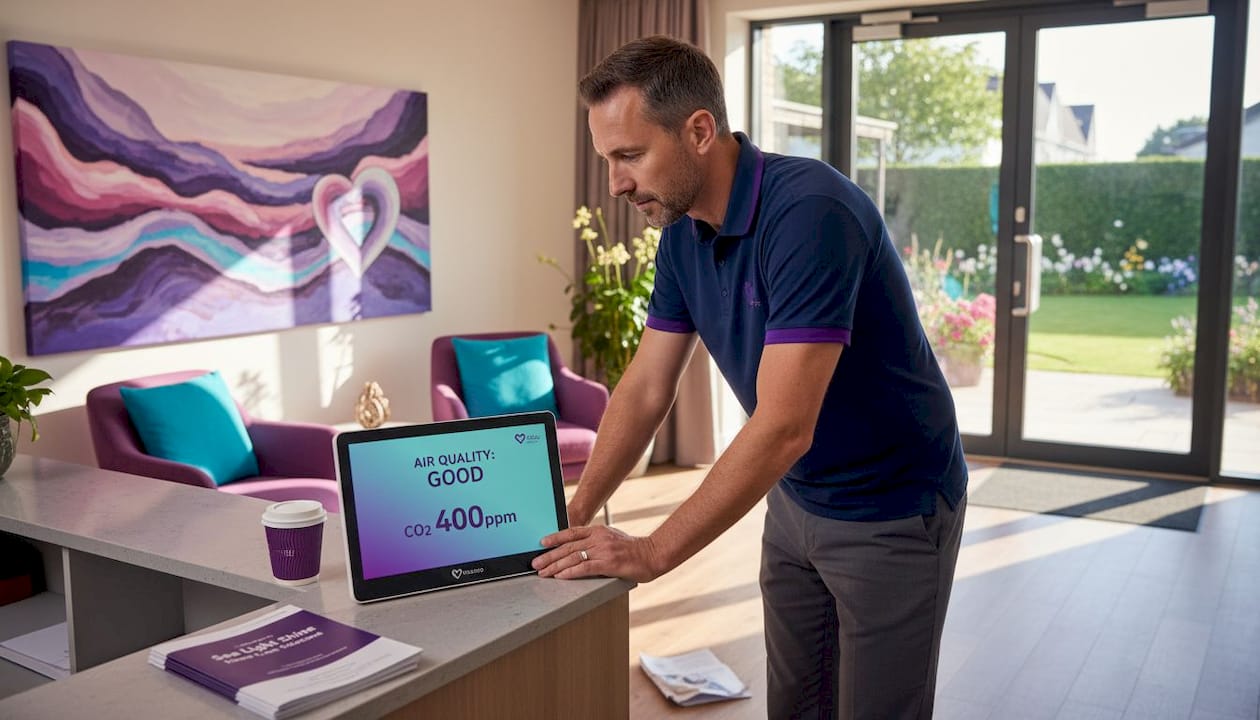
The consequences for property health and cleaning quality are real and measurable. Staff in buildings with poor air quality report higher rates of headaches, fatigue, and respiratory irritation. In commercial properties, this translates into reduced concentration, more sick days, and higher staff turnover. For landlords and property managers, it also means accelerated wear on building fabric, HVAC components, and furnishings.
Common facility mistakes that defeat air quality systems:
- Dry dusting that displaces particles into the air rather than capturing them
- Neglecting ventilation grilles and air handling unit filters during routine cleans
- Using cleaning products with high VOC content in poorly ventilated spaces
- Allowing moisture to linger on surfaces, creating conditions for mould growth
- Infrequent deep cleaning of carpets, soft furnishings, and ceiling fixtures
Pro Tip: Co-ordinate your cleaning schedule with your building’s air-handling maintenance calendar. Cleaning ventilation grilles and replacing filters on the same day as a deep clean maximises the benefit of both activities and prevents the cycle of recontamination.
Consistency at scale: How professional vendors deliver reliability
For property managers overseeing multiple sites, or business owners with growing premises, consistency is the hardest thing to maintain. A cleaning standard that works well in one location can deteriorate rapidly in another if it depends on individual effort rather than a structured system.
This is where professional cleaning vendors demonstrate their clearest advantage. Established providers use digital quality control tools, structured recruitment processes, and documented handover procedures to ensure that the standard delivered on Monday morning at one site matches the standard delivered on Friday evening at another. They do not rely on goodwill or memory. They rely on systems.
Common points of failure in manual, non-professional operations include:
- Staff turnover leaving knowledge gaps that are never formally filled
- Inconsistent product use when different team members apply their own judgement
- No quality checks meaning problems accumulate unnoticed between management visits
- Poor handovers when one cleaner covers for another without a written brief
- Scaling problems when a system that worked for one site is simply replicated without adaptation for a larger or different premises
Professional vendors address every one of these failure points through structured operations. As industry guidance confirms, structured cleaning operations using SOPs, quality control checks, and standardised methods reduce operational disruptions and support reliable multi-site delivery.
“Cleaning vendors improve consistency through structured operations, which reduces operational disruptions and supports reliable multi-site delivery.” — Multi-site Cleaning Operations Guide, 2026
For schools, multi-let commercial buildings, and larger hospitality venues across East Anglia, this kind of structured approach is not optional. It is the difference between a building that functions well and one that generates constant complaints, compliance issues, and maintenance costs. Exploring multi-site cleaning management with a professional partner removes the guesswork entirely.
Why professional cleaning is a silent business asset — our perspective
Here is something most facilities guides will not tell you: the businesses in East Anglia that manage their properties best do not treat cleaning as a problem to solve. They treat it as an ongoing investment with measurable returns.
The reactive mindset is common. Something looks bad, smells wrong, or fails an inspection, and then cleaning gets attention and budget. But by that point, the damage is already done. A member of staff has been ill. A client has noticed. An inspector has raised a concern. The cost of fixing a problem is almost always higher than the cost of preventing it.
What separates the most resilient, well-run businesses we work with is that they have built cleaning into their operational metrics. Not just their facilities budget, but their actual business performance indicators. They track staff absence rates. They monitor client feedback on premises presentation. They review inspection outcomes. And they connect all of those data points back to their cleaning programme.
Facilities with high visible and invisible standards attract better staff and better clients. A clean, well-maintained environment signals that a business takes its responsibilities seriously. That signal matters to job candidates, to corporate clients, and to regulators. It is a quiet but powerful competitive advantage.
Our full cleaning solutions guide reflects this philosophy. The businesses that get the most value from professional cleaning are those that stop asking “how little can we spend?” and start asking “what does excellent look like, and how do we maintain it consistently?”
Pro Tip: Add a cleaning performance review to your quarterly business operations meeting. Ask your cleaning partner for a summary of completed tasks, any issues flagged, and recommendations for the next quarter. Treating cleaning as a managed service rather than a background task transforms the value you get from it.
Find a trusted cleaning partner in East Anglia
If the evidence above has made one thing clear, it is that professional cleaning is not simply about appearances. It protects your staff, your compliance position, your building, and your business reputation. Getting it right requires a partner who understands local business needs and delivers consistent, documented, reliable results.
At Sea Light Shine, we built our service specifically around the challenges East Anglia businesses face. We know that unreliable cleaners and inconsistent standards are the two problems that cause the most disruption. That is why every service we offer is built on punctuality, professional training, and transparent communication. Whether you need East Anglia commercial cleaning for a busy office, want to explore what a genuinely thorough clean looks like through our Ipswich professional cleaners case study, or need specialist cleaning services for a managed property, we are ready to help you raise your standard.
Frequently asked questions
Do professional cleaners really reduce workplace illness?
Yes, trained cleaners break chains of transmission by using correct disinfection methods and colour-coded equipment, which reduces illness transmission risk and lowers the likelihood of outbreaks affecting your team.
Are professional cleaners worth it for small East Anglia offices?
Even small offices benefit significantly, as outsourcing to professionals who follow standardised work instructions protects staff health, simplifies compliance, and removes the management burden from your core team.
How does cleaning affect building air quality?
Routine professional cleaning prevents dust and allergen build-up that undermines ventilation systems, and cleaning quality determines whether your air filtration can function as intended.
What problems do standardised cleaning processes solve?
They eliminate inconsistencies between shifts and sites, reduce cross-contamination risk, and ensure accountability, which is why structured cleaning operations are essential for any multi-site or growing business.