Picture this: it’s Monday morning in your Ipswich office. The kitchen bin is overflowing, the meeting room smells stale from Friday’s lunch, and a fine layer of dust coats every desk. Your team shuffles in, notices the state of the place, and their motivation quietly drains away before the first email is even opened. Poor office hygiene is not just unpleasant — it actively costs businesses money through lost productivity, increased sick days, and a damaging first impression on clients. This guide walks you through building a practical, sustainable office cleaning schedule tailored to East Anglia workplaces, so you can protect your team’s health and keep your business running at its best.
Table of Contents
- Why an office cleaning schedule matters
- Assessing your office needs and cleaning zones
- Step-by-step: Building your custom office cleaning schedule
- Troubleshooting and common mistakes to avoid
- How to measure success and make improvements
- Why one-size-fits-all cleaning schedules rarely work
- Need expert support for your office cleaning schedule?
- Frequently asked questions
Key Takeaways
| Point | Details |
|---|---|
| Clean regularly | Frequent, scheduled cleaning prevents hygiene issues and supports productivity. |
| Zone prioritisation matters | Identify high-traffic areas and clean those more often for best results. |
| Tailor your schedule | Customise cleaning routines to your workspace’s needs rather than following a generic template. |
| Monitor and adapt | Regularly review your cleaning outcomes and adapt schedules as your workplace evolves. |
Why an office cleaning schedule matters
A messy, poorly maintained office is more than an aesthetic problem. Research consistently shows that regular office cleaning improves overall hygiene and employee productivity. When staff work in a clean environment, they concentrate better, take fewer sick days, and feel more valued by their employer. When clients or visitors walk in, the state of your office tells them everything about how you run your business.
From a legal standpoint, UK employers have a duty under the Workplace (Health, Safety and Welfare) Regulations 1992 to maintain clean and safe premises. This applies to every office in East Anglia, whether you manage a small team in Bury St Edmunds or a large open-plan space in Norwich. Failing to meet these standards can result in enforcement action, reputational damage, and higher staff turnover.
“A clean office is not a luxury — it is a baseline requirement for any business that takes its people and its clients seriously.”
The most common problems caused by inconsistent cleaning include:
- Rapid spread of colds and viruses through shared surfaces such as keyboards, door handles, and phones
- Build-up of allergens like dust and mould, which worsen respiratory conditions
- Unpleasant odours in kitchens and washrooms that affect morale and client perception
- Clutter accumulation that reduces focus and increases stress levels
- Pest attraction from food debris left in communal areas
Reviewing your office cleaning checklist is the first step towards understanding the full scope of what needs to be addressed. With the need for a proper schedule clear, let’s define what you need before building one.
Assessing your office needs and cleaning zones
Before you write a single task on your schedule, you need to understand your workspace. Every office is different. A busy customer-facing estate agency in Colchester has very different cleaning demands from a quiet back-office accountancy firm in Cambridge. Start by walking through your premises with fresh eyes and mapping out distinct zones.
Highly used office zones and communal areas require more frequent attention than less-accessed spaces. Think about where your team spends the most time, where clients are received, and where food is prepared or consumed.

Here is a simple comparison to help you categorise your zones:
| Zone | Traffic level | Recommended frequency |
|---|---|---|
| Reception and entrance | Very high | Daily |
| Open-plan desks | High | Daily |
| Meeting rooms | Medium to high | After each use and daily |
| Kitchen and break room | Very high | Daily, deep clean weekly |
| Toilets and washrooms | Very high | Daily, thorough clean twice weekly |
| Storage rooms | Low | Weekly or fortnightly |
| Private offices | Medium | Daily light clean, weekly deep clean |
Once you have mapped your zones, gather the right tools for each area. A basic toolkit for most offices includes:
- Microfibre cloths in colour-coded sets (one colour per zone to prevent cross-contamination)
- Multi-surface antibacterial spray for desks and shared equipment
- Glass cleaner for screens, windows, and partitions
- Mop, bucket, and floor cleaner appropriate for your floor type
- Vacuum cleaner with HEPA filtration to capture fine dust and allergens
- Bin liners in multiple sizes
- Toilet cleaner, descaler, and disposable gloves for washroom areas
- Specialist products for kitchen appliances such as microwaves and fridges
If you are unsure whether your current setup meets your professional cleaning needs, it is worth speaking to a specialist before investing in equipment that may not suit your space.
Pro Tip: Colour-code your cleaning cloths by zone and display a simple legend near your cleaning supplies. This one small step prevents bacteria from the washroom being transferred to kitchen surfaces, which is one of the most common hygiene errors in office environments.
Now that you know what to prioritise, you are ready for the actual schedule.
Step-by-step: Building your custom office cleaning schedule
A well-built cleaning schedule removes ambiguity. Nobody argues about whose turn it is to clean the microwave when it is written clearly in black and white. A structured cleaning routine ensures all office tasks are tracked and nothing is overlooked.
The most effective schedules operate on three cycles: daily, weekly, and monthly. Here is a sample framework you can adapt for your own office:
| Task | Area | Frequency |
|---|---|---|
| Empty bins and replace liners | All zones | Daily |
| Wipe down desks and shared surfaces | Open-plan, meeting rooms | Daily |
| Clean and sanitise toilets | Washrooms | Daily |
| Mop hard floors | Kitchen, reception, washrooms | Daily |
| Vacuum carpeted areas | All carpeted zones | Daily or every other day |
| Deep clean kitchen appliances | Kitchen | Weekly |
| Sanitise phones and keyboards | All desks | Weekly |
| Clean internal windows and glass partitions | Throughout | Weekly |
| Dust shelving, skirting boards, and vents | All zones | Weekly |
| Shampoo carpets or deep-clean floors | All areas | Monthly |
| Clean light fittings and ceiling fans | Throughout | Monthly |
| Declutter and reorganise storage areas | Storage rooms | Monthly |
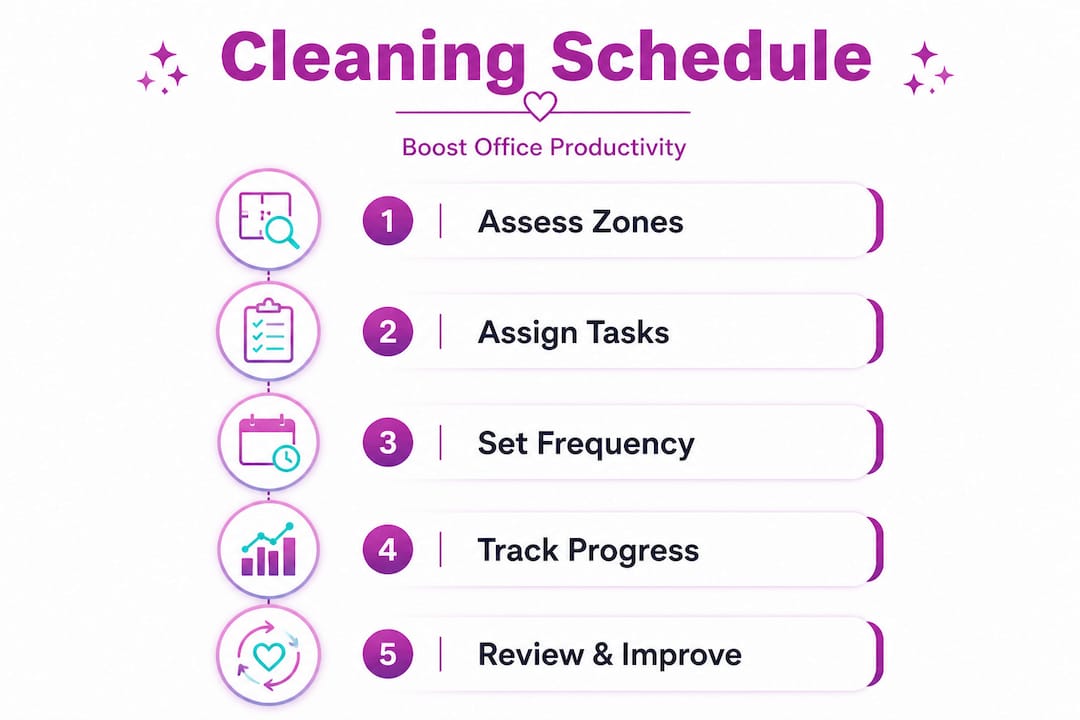
Follow these steps to turn this framework into a working schedule for your office:
- List every cleaning task relevant to your specific workplace, using the zone map you created in the previous section.
- Assign a frequency to each task based on traffic levels and hygiene risk.
- Allocate responsibility clearly. Decide whether tasks will be handled by staff, a dedicated in-house cleaner, or an external contractor. Ambiguity is the enemy of consistency.
- Set a time of day for each task. Early morning before staff arrive is ideal for most daily tasks, as it causes minimal disruption.
- Create a physical or digital log where completed tasks are signed off. This creates accountability and makes it easy to spot gaps.
- Review the schedule monthly and adjust based on feedback and any changes to office use.
Clear, visible cleaning schedules improve accountability and performance across the board. Pin your schedule in the kitchen, the cleaning cupboard, and anywhere else relevant staff will see it regularly.
If your office undergoes renovation or fit-out work, you may also need to factor in specialist post-construction cleaning before your regular schedule resumes. For businesses considering outsourcing, reviewing contract cleaning guidance can help you understand what to expect from a professional provider.
Pro Tip: Build a five-minute “reset” into the end of every working day where each team member tidies their own desk and disposes of any food waste. This small habit dramatically reduces the burden on your cleaning team and keeps the office presentable between professional cleans.
With your plan drafted, it is important to avoid common snags as you put it into action.
Troubleshooting and common mistakes to avoid
Even the best-designed cleaning schedule can fall apart in practice. The most common reason? Nobody feels personally responsible for it. Consistency and staff engagement keep cleaning schedules effective and sustainable over the long term.
Watch out for these frequent pitfalls:
- Vague task descriptions. “Clean the kitchen” means different things to different people. Be specific: wipe down all surfaces, clean the hob, empty the dishwasher, and sanitise the sink.
- No named owner for each task. When everyone is responsible, no one is. Every task needs a name or a role attached to it.
- Ignoring seasonal changes. East Anglia winters bring mud, wet footprints, and increased illness. Your schedule should reflect this with more frequent floor cleaning and surface sanitising during colder months.
- Skipping the review cycle. A schedule written in January may not suit a team that has doubled in size by June. Build in quarterly reviews as a minimum.
- Underestimating deep clean requirements. Light daily cleaning does not replace periodic deep cleaning. Grout, upholstery, and air vents accumulate grime that regular surface cleaning cannot address.
If standards begin to slip, act quickly. Start by having an honest conversation with whoever is responsible for cleaning. If the issue is workload, consider whether the frequency or scope of tasks needs adjusting. If reliability is the problem, it may be time to look at selecting cleaning professionals rather than relying on ad hoc arrangements.
Understanding cleaning service costs in your area is also useful when making the case to management for a proper cleaning budget. Many business owners are surprised to find that professional services are far more affordable than they assumed, especially when weighed against the cost of lost productivity from a poorly maintained office.
With pitfalls managed, you can feel confident your cleaning schedule will deliver.
How to measure success and make improvements
A cleaning schedule is only as good as the results it produces. Measuring those results keeps your approach honest and helps you improve over time. Regular reviews and feedback loops lead to continuous improvement of cleaning routines, and this principle applies whether you manage cleaning in-house or outsource it.
Key benchmarks for a clean, well-maintained office include:
- No visible dust on desks, shelving, or equipment at the start of each working day
- Washrooms stocked with soap, paper towels, and toilet tissue at all times
- Kitchen surfaces free from food residue and appliances clean inside and out
- Floors free from debris, stains, and scuff marks
- No persistent odours in any area of the office
- Waste bins emptied before they overflow
Gathering staff feedback is one of the most underused tools in cleaning management. A simple monthly survey, even just three questions sent by email, can surface issues that a manager walking through the office might miss. Ask your team what areas feel neglected, what supplies run out most often, and whether the current schedule fits around their working patterns.
Offices that actively seek and act on staff feedback about cleanliness report noticeably higher satisfaction scores in workplace surveys.
When to revisit your cleaning plan:
- After a significant change in staff numbers
- Following a move to new premises or a refurbishment
- After a period of illness affecting multiple staff members
- When client feedback mentions cleanliness or presentation
- At the start of each new season, particularly autumn and winter
Working with commercial cleaning contractors who provide regular performance reports can also take the guesswork out of this process, giving you documented evidence that standards are being met.
Why one-size-fits-all cleaning schedules rarely work
Here is something we have learned from working with businesses across East Anglia: the offices that struggle most with cleanliness are rarely the ones with the dirtiest teams. They are the ones using a generic schedule downloaded from the internet and applied without any thought to how their specific workplace actually operates.
A law firm in Norwich that hosts client meetings throughout the day has completely different needs from a logistics company in Felixstowe where the office is only occupied from 9am to 1pm. Applying the same daily task list to both is a waste of resources in one case and dangerously inadequate in the other.
We have seen tailored office cleaning approaches deliver remarkable results for businesses that previously thought they had a “cleaning problem.” In most cases, the problem was not effort or budget. It was a mismatch between the schedule and the reality of how the office was used.
Flexibility matters too. As your team grows, as working patterns shift, or as you take on new premises, your cleaning schedule must evolve with you. Treat it as a living document, not a one-time task. The businesses that get this right are the ones that review, adjust, and communicate regularly — and that is a habit worth building from day one.
Need expert support for your office cleaning schedule?
Building a cleaning schedule is one thing. Maintaining it consistently, week after week, while running a business is another challenge entirely. That is where professional support makes a genuine difference for business owners and property managers across East Anglia.

At Sea Light Shine, we specialise in commercial office cleaning that is built around your specific workplace, your hours, and your standards. We do not offer a generic service — we assess your space, understand your priorities, and create a cleaning plan that actually fits. Our team is punctual, reliable, and trained to deliver consistent results every visit. If you want to see what that looks like in practice, take a look at our Ipswich cleaning case study to understand how we approach even the most demanding commercial environments. Get in touch today for a no-obligation conversation about your office cleaning needs.
Frequently asked questions
How often should office cleaning tasks be scheduled?
High-traffic areas such as washrooms, kitchens, and reception zones should be cleaned daily, while lower-traffic spaces like storage rooms can be addressed weekly or fortnightly for optimal hygiene.
What should an office cleaning schedule include?
Your schedule should cover daily, weekly, and monthly tasks for every office zone. A structured cleaning routine ensures nothing is overlooked, from desk surfaces and meeting rooms to kitchen appliances and washroom facilities.
How do you make staff stick to a cleaning schedule?
Assign named responsibilities for each task, post visible cleaning schedules in communal areas, and use a sign-off log to build accountability and keep standards consistent over time.
Is it better to hire professionals or organise cleaning in-house?
For most businesses, professional cleaning services deliver higher and more consistent standards, particularly for larger offices or spaces with specialist requirements such as deep cleaning or post-construction work.