Many people assume a domestic cleaning service simply means someone coming round to tidy up. In reality, professional home cleaning, the recognised industry term for what is commonly called a domestic cleaning service, covers a structured range of hygiene and maintenance tasks designed to protect your health, your home, and your time. Whether you rent a flat in Ipswich or own a house in Suffolk, understanding what domestic cleaning actually involves helps you make smarter decisions about your living space. This guide covers the scope, the benefits, the types of service available, and how to choose one you can trust.
Table of Contents
- Key takeaways
- What is a domestic cleaning service?
- The real benefits of domestic cleaning
- Types of domestic cleaning services
- How to choose a cleaning service
- Technology and the future of home cleaning
- My take on what domestic cleaning is really worth
- How Sealightshine can help
- FAQ
Key takeaways
| Point | Details |
|---|---|
| More than tidying | Domestic cleaning covers structured hygiene tasks that protect health and prevent long-term home damage. |
| Significant time savings | A recurring professional clean can save households 3 to 5 hours of manual labour every week. |
| Health and wellness benefits | Regular professional cleans reduce allergens, dust mites, and mould, supporting better air quality and mental wellbeing. |
| Know the difference | Standard domestic cleaning and deep cleaning are not the same. Booking the wrong one leads to unmet expectations. |
| Choose with care | Always check for insurance, references, and pricing transparency before committing to any cleaning provider. |
What is a domestic cleaning service?
A domestic cleaning service is a professional arrangement where trained cleaners visit your home on a regular or one-off basis to carry out a defined set of cleaning and hygiene tasks. The domestic cleaning meaning goes well beyond picking things up off the floor. A typical visit covers dusting surfaces and shelves, vacuuming carpets and rugs, mopping hard floors, wiping down kitchen worktops, cleaning bathroom fixtures, emptying bins, and sanitising high-touch areas like door handles and light switches.
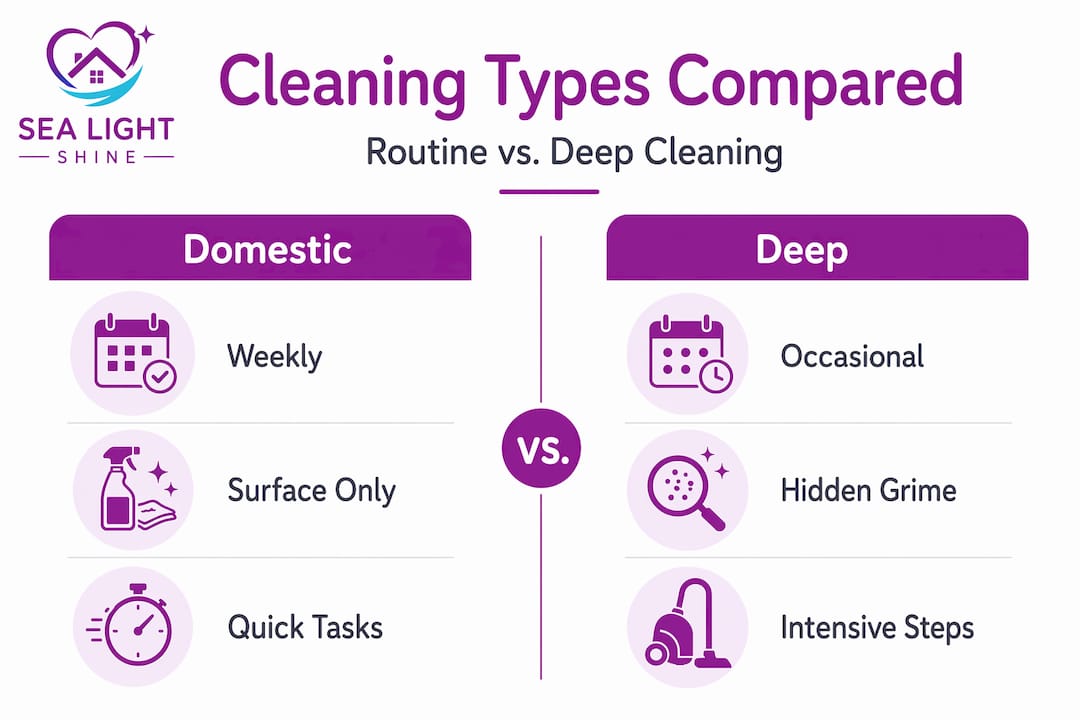
What domestic cleaning does not automatically include is deep cleaning. Deep cleaning targets hidden grime and long-term buildup in areas that regular maintenance simply does not reach, such as behind appliances, inside ovens, inside fridge drawers, limescale buildup in showers, or grout between tiles. Many people underestimate the labour involved in a proper deep clean compared to a standard visit, which is why misaligned expectations are so common when booking for the first time.
The table below shows how the three most commonly confused concepts compare:
| Type | Focus | Frequency | Typical tasks |
|---|---|---|---|
| General tidying | Surface-level order | Daily | Putting items away, wiping spills |
| Domestic (standard) cleaning | Hygiene and maintenance | Weekly or fortnightly | Vacuuming, mopping, bathroom and kitchen cleaning |
| Deep cleaning | Intensive removal of buildup | Monthly or occasional | Oven interiors, grout, behind appliances, skirting boards |
Pro Tip: If you are booking a professional cleaner for the first time after a long gap, start with a deep clean. It resets the baseline so that ongoing standard visits stay manageable and cost-effective.
Understanding this distinction, and exploring standard versus deep cleaning before you book, saves you both money and disappointment.
The real benefits of domestic cleaning
The advantages of regular home cleaning stretch well beyond a tidy living room. Here is what the evidence actually shows.
Health and air quality
A weekly professional clean helps reduce dust mites, kill germs, stop mould growth, and improve air quality, particularly for anyone with allergies, asthma, or other respiratory conditions. Dust and mould spores accumulate faster than most people expect. A fortnight without vacuuming in a carpeted bedroom can meaningfully worsen indoor air quality.
Mental wellness and stress reduction
Routine cleaning is increasingly viewed as a wellness strategy, not just a chore. Regularly tidying and organising reduces visual clutter, which lowers cortisol levels and supports better sleep quality. If you have ever felt inexplicably anxious in a cluttered room and calmer in a clean one, that is not imagination. It is physiology.
“A clean home is not a luxury. It is one of the most accessible and underrated tools for mental clarity and daily calm.”
Time and lifestyle
Hiring a recurring service saves households an estimated 3 to 5 hours of manual labour every week. For a working couple or a parent managing a full schedule, that time is genuinely significant. It is the difference between a relaxed Saturday morning and one spent scrubbing bathroom tiles.
Protection of your home
Grease builds up. Limescale damages taps. Dust settles into vents and appliances. Regular cleaning prevents the kind of slow, invisible damage that leads to expensive repairs or replacements down the line. Think of it as maintenance, not a luxury.
Pro Tip: Track how you feel on the days a cleaner visits versus days you have not cleaned in a while. Most people notice a measurable difference in focus and mood. That data point is worth more than any brochure.
You can read more about how cleaning frequency affects wellbeing and how to structure your routine accordingly.
Types of domestic cleaning services
The market for professional home cleaning has developed considerably. You are no longer choosing between “someone comes round weekly” and nothing. Here is a breakdown of the main options.
Routine cleaning schedules
Most domestic cleaning providers offer visits on a weekly, fortnightly, or monthly basis. Weekly cleans are best for households with children, pets, or anyone with allergies. Fortnightly works well for tidier households or single occupants. One-off cleans serve a specific need, such as moving in or out of a property, a post-party clean, or a seasonal refresh.
Specialist add-ons
Beyond standard visits, you can typically book:
- Oven deep cleaning (a task most people dread and genuinely difficult to do well at home)
- Fridge cleaning, including door seals and shelving
- Interior window cleaning
- Linen changes and laundry
- Carpet cleaning
- Post-construction or renovation cleans
Agency versus independent cleaner
This is a decision worth thinking through carefully. Professional cleaning agencies are generally insured and bonded, which protects you against liability, accidental damage, or a missing item. Independent cleaners are often cheaper, but you take on more responsibility for vetting them yourself.
The typical pricing difference reflects that distinction. Traditional professional cleaning services for a standard home range between £150 and £300 per visit depending on size and condition, while independent cleaners may charge less. Neither is automatically better. It depends on what peace of mind is worth to you.
| Service model | Typical cost per visit | Insurance | Consistency |
|---|---|---|---|
| Independent cleaner | Lower | Usually none | Variable |
| Agency cleaner | Moderate to higher | Generally included | More consistent |
| One-off specialist | Higher per visit | Varies | Task-specific |
For anyone wondering about how to hire a reliable domestic cleaner, starting with a structured checklist of questions makes a real difference to the outcome.
How to choose a cleaning service
Choosing a domestic cleaning provider is not complicated, but it does require a few deliberate steps. Rushing the decision is how people end up with unreliable service or worse, someone they cannot trust in their home.
Work through these steps before you commit:
- Check for insurance and vetting. Any reputable agency will confirm their cleaners are insured, DBS checked, and reference-verified. Ask directly. If the answer is vague, that tells you something.
- Read actual reviews. Not just star ratings. Look for specific comments about reliability, communication, and what happens when something goes wrong. Negative reviews handled well are often more reassuring than a perfect score.
- Ask about what is and is not included. Every provider has a different scope. One company’s “standard clean” includes bathroom sanitisation; another’s does not. Get a written list before the first visit.
- Request a trial session. Many services offer an introductory clean. Treat it as an interview. You are assessing their attention to detail, punctuality, and whether they follow through on what was agreed.
- Understand pricing transparency. Avoid services that quote vaguely. A reputable provider will break down costs clearly, including any travel or product charges.
Professional cleaners use specialised tools and set routines with checklists to deliver consistent results. That structure is part of what you are paying for. An independent cleaner who brings their own products and has no checklist may still do excellent work, but the risk of inconsistency is higher.
Pro Tip: After the trial clean, walk through each room with your own checklist. Note what was done well and what was missed. Share that feedback before the second visit. Good cleaners welcome specifics. Great ones act on them.
Technology and the future of home cleaning
Automation is beginning to make its presence felt in the domestic cleaning market, though not in the way most people expect.
Robot vacuum cleaners are already widely used as supplements to human cleaning. They handle daily dust maintenance between professional visits, particularly useful in homes with pets or hard floors. They do not replace a thorough clean, but they extend the interval between visits without the home deteriorating noticeably.
The more significant shift is in commercial-grade robotic services. In 2026, autonomous humanoid robot cleaning services entered the consumer market, offering flat-fee pricing and operating without human supervision. This represents a genuine structural shift in how domestic cleaning services may be delivered in the coming years.
For now, the practical picture for most homeowners looks like this:
- Robot vacuums and mops handle light daily maintenance
- Human cleaners deliver the judgement, care, and thoroughness that machines cannot yet replicate for detailed tasks
- Specialist tasks like oven cleaning, grout scrubbing, or linen changes remain firmly in human hands
Technology complements professional cleaning. It does not replace the person who notices your bathroom sealant is cracking and mentions it before it becomes a leak. The consumer cleaning market will keep evolving, but for the foreseeable future, experienced human cleaners remain the gold standard for thorough, reliable home care.
My take on what domestic cleaning is really worth
I have spent years watching how people relate to their homes, and one pattern stands out. The people who resist hiring a professional cleaner almost always cite cost first. But when you press a little, the real barrier is guilt. Somehow, paying someone to clean feels like admitting something, as if maintaining a clean home should be effortless and free.
What I have actually seen, again and again, is that the first time someone comes home to a professionally cleaned space, their reaction is rarely “that was a waste of money.” It is usually closer to genuine relief. That is not a small thing. A clean, ordered home changes how you feel from the moment you walk through the door.
I also think the domestic cleaning vs commercial cleaning distinction matters less to most people than the question of reliability. The horror stories are almost always about a cleaner who was fine for three visits and then became impossible to reach, or who did half the job and left. That is why I believe the most underrated factor in choosing a service is not price or even quality. It is accountability. Does the provider have a clear process for when things go wrong? Will someone actually pick up the phone?
Neglecting regular cleaning consistently costs more in the long run. Not just in repairs and replacements, but in the subtle daily tax of living in a space that feels out of control. Viewing professional cleaning as an investment in your quality of life, rather than an extravagance, shifts the entire calculation.
You can find practical guidance on maintaining a clean home between professional visits, which helps you get more value from every booking.
— Kate
How Sealightshine can help
At Sealightshine, we built our service around one problem: too many homeowners and renters in East Anglia were dealing with unreliable cleaners and inconsistent results. Our team is fully insured, punctual, and trained to a consistent standard on every visit. Whether you need a regular weekly clean, a thorough deep cleaning in Ipswich, or a specialist one-off service, we offer flexible scheduling and transparent pricing with no vague quotes. We work with homeowners, renters, landlords, and Airbnb hosts across East Anglia. If you are ready to stop settling for inconsistent service, explore our home cleaning checklist to understand what a proper clean should cover, then get in touch.
FAQ
What does a domestic cleaning service include?
A domestic cleaning service typically includes vacuuming, mopping, dusting, surface wiping, bathroom and kitchen cleaning, and bin emptying. Specialist tasks like oven or fridge cleaning are usually booked as add-ons.
What is the difference between domestic and deep cleaning?
Domestic cleaning covers regular hygiene maintenance, while deep cleaning targets accumulated grime in hard-to-reach areas like oven interiors, grout, and behind appliances. Deep cleaning requires significantly more time and labour than a standard visit.
How often should I book a domestic cleaning service?
Weekly cleans suit households with children, pets, or allergy sufferers. Fortnightly works well for smaller or tidier homes. Most providers offer flexible scheduling so you can adjust frequency as your needs change.
Is it better to use an agency or an independent cleaner?
Agencies provide insurance, accountability, and vetted staff, which offers greater security. Independent cleaners may cost less but typically carry no insurance, placing more responsibility on the homeowner to vet and manage them directly.
How much does a domestic cleaning service cost in the UK?
Costs vary based on home size, location, and service type. A standard professional clean for a typical home generally falls between £80 and £200, with deep cleans priced higher due to the additional time and specialist products involved.