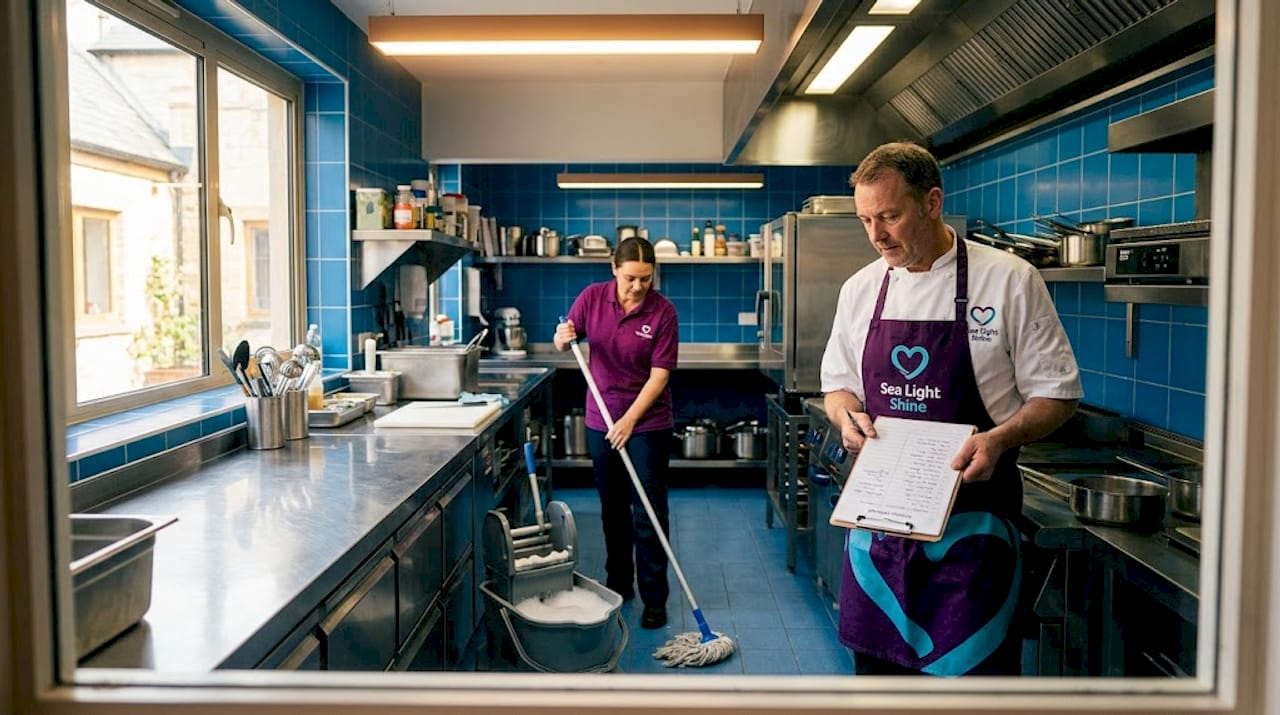
Running a commercial kitchen in East Anglia means environmental health officers can walk through your door without warning. A deep clean commercial kitchen guide is not just a cleaning checklist — it is your compliance strategy, your fire risk reduction plan, and your defence against a failed Food Hygiene Rating Scheme inspection. Get it right, and you protect your business, your staff, and every customer who sits down to eat. Get it wrong, and a single inspection failure can close your doors.
Table of Contents
- Understanding the requirements for deep cleaning a commercial kitchen
- Preparing for a deep clean: tools, materials, and staging
- Step-by-step deep cleaning process for commercial kitchens
- Verifying and documenting your deep cleaning for compliance success
- Common challenges and troubleshooting tips for deep cleaning
- The unseen value of validated deep cleaning in kitchen compliance
- Professional deep cleaning services for East Anglia commercial kitchens
- Frequently asked questions
Key Takeaways
| Point | Details |
|---|---|
| Scheduled deep cleaning | Regular deep cleaning every 3-6 months prevents contamination and meets Environmental Health Officer expectations. |
| Thorough preparation | Staging equipment and using appropriate food-safe products improves cleaning efficiency and effectiveness. |
| Validated cleaning | Verification with ATP swabs and documented logs proves sanitation and supports HACCP compliance. |
| Address hidden areas | Cleaning behind heavy equipment, vents, and drains is key to removing grease build-up and passing inspections. |
| Documentation is essential | Maintaining hygiene folders with certificates and signed schedules is critical for unannounced inspection readiness. |
Understanding the requirements for deep cleaning a commercial kitchen
Before you lift a scrubbing brush, you need to know what the regulations actually demand. Many kitchen managers assume that daily cleaning routines satisfy Environmental Health Officers (EHOs). They do not.
Commercial kitchens require deep cleaning every 3 to 6 months based on usage to meet EHO standards, with high-volume operations typically needing quarterly deep cleans. A busy fish and chip kitchen in Norwich operates very differently to a small café in Bury St Edmunds — and EHOs factor in that context when they inspect.
The Food Safety Act 1990 and the Food Standards Agency’s FSQMS framework require validated cleaning schedules documented by signed logs and microbiological testing. Validation means you cannot simply say the kitchen is clean — you must prove it, with records.
Understanding regular kitchen deep cleaning requirements and how they apply to food businesses gives you a sharper understanding of what EHOs are looking for when they walk through your door.
Here is what compliance-focused deep cleaning must address:
- HACCP (Hazard Analysis and Critical Control Points) obligations, which require documented sanitation as part of your food safety management system
- Ventilation systems cleaned to TR19 standard, covering grease extraction and ducting
- Documented evidence of ATP swab testing or microbiological verification on food-contact surfaces
- Signed master sanitation schedules with dated staff signatures
- Supplier invoices for cleaning chemicals as proof of appropriate product use
The commercial deep cleaning guide for commercial premises covers broader compliance points that connect directly to kitchen operations.
Documentation and the physical clean are equally weighted. EHOs have been known to rate a visibly clean kitchen poorly because the paperwork was absent. Know that before you start.
Preparing for a deep clean: tools, materials, and staging
With requirements clear, the next step is properly preparing your kitchen and tools for an effective deep clean. Rushing into a deep clean without staging your equipment and supplies first costs hours and often produces patchy results.
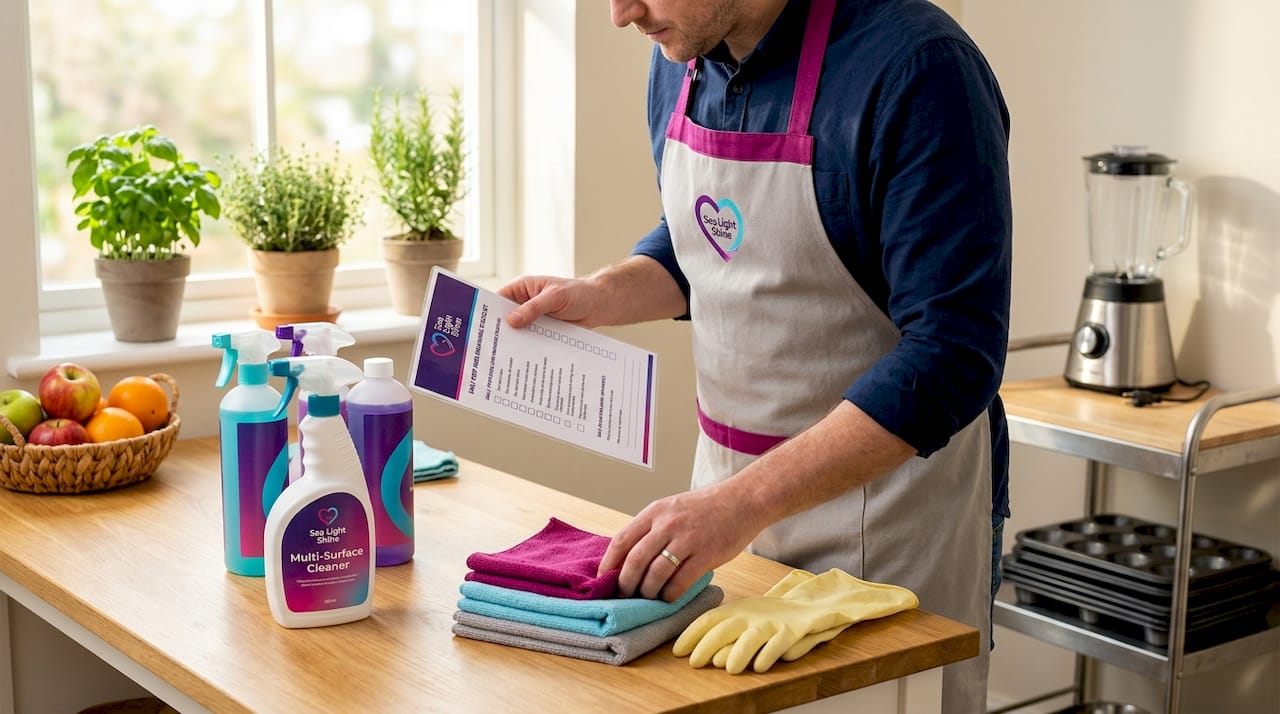
Effective deep cleaning demands powering down equipment, clearing food and waste, and using food-safe degreasers appropriate to each surface. This is not something you improvise on the day.
Cleaning supplies reference table
| Item | Purpose | Surface type |
|---|---|---|
| Food-safe alkaline degreaser | Breaks down grease on metal and tiles | Hoods, ovens, fryers, walls |
| Enzymatic drain cleaner | Digests organic matter in drains | Floor drains, grease traps |
| Long-handled stiff brush | Scrubs overhead and hard-to-reach areas | Ventilation grilles, shelving tops |
| Drain snake (flexible auger) | Clears blocked or greased drain pipes | Below floor level |
| Microfibre cloths | Captures bacteria without spreading it | All food-contact surfaces |
| ATP swab kit | Verifies hygiene levels post-clean | Food-contact surfaces |
| Non-scratch scouring pads | Removes carbon buildup without damage | Stainless steel surfaces |
The night before a scheduled deep clean, remove and soak all removable parts including hood filters, grates, and burner components. This one step alone cuts your cleaning time by 30 to 40 minutes because the degreaser does the heavy work overnight.
Your commercial kitchen cleaning tools need to match the surfaces you are treating. Abrasive pads on coated surfaces cause micro-scratches that harbour bacteria. Alkaline degreasers on aluminium cause oxidation. Match the product to the material.
Essential pre-clean preparation steps:
- Switch off and tag out all electrical equipment the night before
- Pre-soak removable parts in degreaser solution overnight
- Check ventilation access panels and order replacement gaskets if worn
- Brief your team on the cleaning order and individual responsibilities
- Prepare PPE including gloves, goggles, and non-slip footwear
Pro Tip: Create a laminated prep checklist for your kitchen notice board. When a deep clean falls on a busy close-down evening, this removes any ambiguity about who does what and prevents the prep stages being skipped.
Step-by-step deep cleaning process for commercial kitchens
Now that you are prepared, this section guides you through the detailed cleaning steps from start to finish. Order matters. Work top-down so that falling debris and cleaning solution do not recontaminate surfaces you have already cleaned.
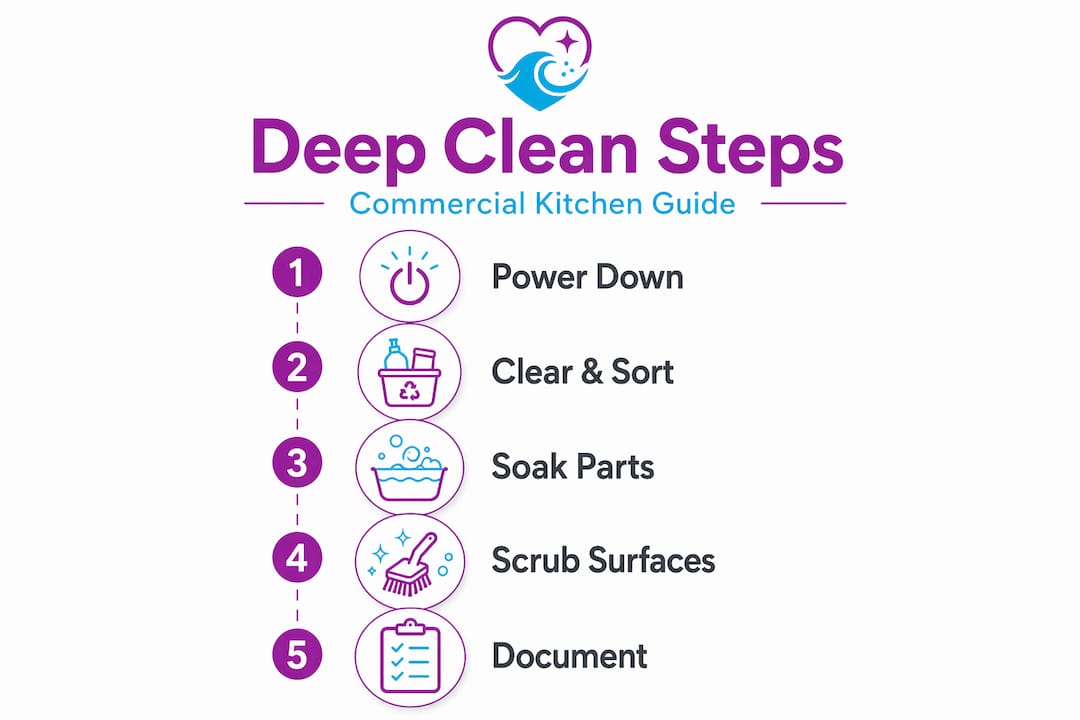
A successful deep clean starts at the top: vents, walls, equipment, then floors to prevent recontamination.
The cleaning sequence
- Power down and cool all equipment. Never clean hot surfaces or introduce water near live equipment. Allow at minimum 30 minutes for cooling after shutdown.
- Remove all food, waste, and debris. Empty fridges, clear surfaces, remove stored items from shelving. Nothing gets cleaned around.
- Degrease overhead ventilation hoods and filters. Apply alkaline degreaser, allow 10 to 15 minutes of dwell time, then scrub and rinse. Repeat for particularly heavy buildup.
- Scrub walls, tiled splashbacks, and shelving. Use long-handled brushes for upper sections. Pay particular attention to wall and ceiling junctions where grease vapour settles.
- Clean all cooking equipment surfaces. Strip down fryers, ovens, and grills. Soak removable components that were not prepped overnight.
- Pull heavy equipment out such as ovens and fryers to clean underneath and behind, targeting hidden grease that EHOs check first.
- Clean refrigeration units, storage areas, and shelving. Defrost and wipe down fridge interiors. Wash and dry shelving before restocking.
- Clean floor and drain areas last. Scrub floor grout, use an enzymatic drain cleaner, and snake the drain pipes if needed.
Cleaning method comparison
| Method | Pros | Cons | Best for |
|---|---|---|---|
| Manual scrubbing | No specialist equipment needed | Time-intensive, physical strain | Surfaces and shelving |
| Soak and rinse | Reduces scrubbing effort on heavy buildup | Requires pre-planning overnight | Filters, grates, fryer baskets |
| Steam cleaning | Chemical-free, kills bacteria | Equipment cost, not for all surfaces | Tile grout, equipment crevices |
| Pressure washing | Fast coverage on floors | Risk of spreading contamination if misused | Floor areas with drainage |
Pro Tip: Schedule deep cleans immediately after your last service of the week rather than before your first. The kitchen is already cooling, staff are present, and you gain the maximum time before reopening.
“The spaces that matter most to EHOs are the ones you cannot see without moving equipment. A kitchen that looks immaculate at bench height can be hiding a fire risk three centimetres behind the fryer.”
Verifying and documenting your deep cleaning for compliance success
Completing the clean is not enough. You need to verify and prove your efforts to regulators, insurers, and your own team.
Validation via ATP swabbing or microbiological tests is the standard method for demonstrating cleaning effectiveness under HACCP. ATP swab kits measure biological residue in Relative Light Units (RLU). A score of below 10 RLU on food-contact surfaces is the accepted benchmark in professional kitchen environments.
A hygiene folder with signed checklists and supplier records supports FHRS success and satisfies EHOs during inspections.
Your deep cleaning documentation system should contain the following:
- Master sanitation schedule listing every area, frequency, responsible staff member, and sign-off column
- ATP swab results with date, surface tested, and RLU score
- Cleaning product COSHH data sheets and supplier invoices as proof of food-safe product use
- Staff training records showing hygiene induction and updates
- EHO correspondence and past inspection reports for context
Rotate staff verification duties weekly. When one team member is always responsible for checking a particular area, blind spots develop. Rotation keeps verification honest.
Pro Tip: EHOs are far more likely to downgrade a business because its documentation is disorganised than because a single shelf was missed. Arrive at every inspection with a complete, chronological folder that an officer can work through in under five minutes.
Wash cloths and mop heads at 60°C minimum at the end of every deep clean session. Cloths washed below this temperature can harbour Listeria and re-introduce contamination to surfaces you have just verified as clean.
Common challenges and troubleshooting tips for deep cleaning
Understanding challenges prepares managers to overcome obstacles and maintain a consistent cleaning programme. Every commercial kitchen has its own quirks, and a step-by-step kitchen deep clean that works perfectly in one site can hit friction in another.
Soak-based cleaning methods reduce both labour and water usage while efficiently breaking down grease and carbon, which is why pre-staging removable parts is so valuable when time is tight.
Common challenges and how to address them:
- Stubborn grease and carbon buildup: A single application of degreaser rarely shifts heavy deposits. Apply the product, cover with cling film to retain moisture and extend dwell time, then scrub. A second application often completes the job without abrasive damage.
- Time constraints: Break the deep clean into zones and rotate them across multiple close-down sessions rather than attempting the full kitchen in a single night. This works well for lower-risk areas while keeping critical zones on a full quarterly schedule.
- Limited access to overhead and corner areas: Invest in adjustable long-handled tools. A 1.5 metre brush with a swivel head handles ventilation grilles and overhead pipework without scaffolding or unsafe step ladders.
- Persistent odours after cleaning: Odours almost always indicate a source that has not been addressed, typically a grease trap, drain, or unseen spill behind equipment. Masking odour with product is never a solution, and it signals to EHOs that a problem exists.
- Staff inconsistency: A well-meaning team with no structured commercial kitchen cleaning checklist produces inconsistent results. Laminated zone checklists with tick boxes and photo evidence requirements remove ambiguity.
Pro Tip: Stage all removable parts the evening before your deep clean and use a flexible zone rotation schedule. You will find that most time-pressure problems in commercial kitchen maintenance disappear when the heavy prep work is separated from the actual cleaning session.
The unseen value of validated deep cleaning in kitchen compliance
Here is a view you will not find in most kitchen hygiene guides: the biggest compliance risk in commercial kitchens is not a dirty surface. It is the false confidence that comes from a kitchen that looks clean.
EHOs focus more on documented sanitation evidence than merely visible shine during unannounced inspections. A kitchen with gleaming worktops but no ATP records, no signed schedules, and no verification process is one that cannot prove it is safe. That distinction matters enormously when an officer is deciding your Food Hygiene Rating.
Hidden grease accumulates in ways daily cleaning never touches: inside extraction ducting, beneath fryer bases, in the joins between equipment and tiled walls. These are not visible during service. They are only revealed during a structured deep clean with access to the spaces that normal cleaning ignores. That hidden grease is also a fire risk, not just a hygiene one.
The importance of documented cleaning goes beyond compliance paperwork. Businesses that embed cleaning verification into staff culture, rather than treating it as a box-ticking exercise, consistently outperform those that treat hygiene as reactive. Staff who understand why they are swabbing a surface, not just that they must, produce better results and catch problems earlier.
Investing in training, documentation, and routine verification also extends equipment life. Fryers cleaned and maintained properly last significantly longer. Ventilation systems kept clear of grease run more efficiently and consume less energy. The return on consistent, validated deep cleaning is measurable in ways that go well beyond avoiding a poor inspection score.
Professional deep cleaning services for East Anglia commercial kitchens
Managing every element of a compliant deep cleaning programme in-house is demanding, especially when your priority is running a food business. For East Anglia kitchen managers who want to ensure their clean is verifiable, documented, and done right, professional support makes a real difference.
Sea Light Shine provides commercial cleaning services specifically designed for food business environments across East Anglia. Our kitchen deep cleans are scheduled around your operations, typically out of hours, so your service is never compromised. Every clean includes detailed reports and hygiene documentation that supports your EHO folder directly. You can read more about our approach in our professional deep cleaning guide for commercial premises. For businesses weighing up whether to bring in external support, our overview of the benefits of professional cleaners for East Anglia businesses sets out what to expect in practical terms.
Frequently asked questions
How often should a commercial kitchen in East Anglia be deep cleaned?
Most commercial kitchens require deep cleaning every 3 to 6 months depending on volume, with high-use kitchens needing quarterly cleans to comply with EHO guidelines.
What areas are most critical to include in a deep clean?
Critical areas include ventilation hood systems, grease traps, behind and under heavy equipment, wall seams, drains, and floors. EHOs check hidden grease traps behind heavy equipment and expect full TR19-compliant ventilation cleaning.
How can I verify that a deep clean was effective?
Validation via ATP swabbing or microbiological tests proves cleaning effectiveness and satisfies HACCP requirements. A result below 10 RLU on food-contact surfaces is the accepted benchmark.
Can deep cleaning be done during business hours?
Deep cleaning is best scheduled during off-peak times or closures to avoid disruption and cross-contamination risks. Professional deep cleaning services provide flexible out-of-hours options to minimise business disruption.
What documentation should I keep for EHO inspections?
Maintain a hygiene folder with signed cleaning schedules, verification logs, certificates, and supplier invoices. A hygiene folder with signed checklists and supplier records supports inspection readiness and FHRS success.