A working office kitchen hygiene policy needs five fixed elements: a short code of conduct, a daily/weekly/monthly task schedule, named owners for each task, a set fridge reset day, and documented COSHH/SDS compliance for every cleaning chemical on site. Without all five, standards slip within weeks, no matter how well-meaning your team is.
Start today with three things:
- Post a fridge purge notice stating the day and time unlabelled food gets binned.
- Locate (or request) Safety Data Sheets for every cleaning product currently under your sink.
- Buy a cheap appliance thermometer and check your fridge sits at or below 5°C.
For the legal groundwork, Gov and the HSE’s COSHH basics are the two references worth bookmarking before you write a word of policy.
Key Takeaways
A working office kitchen hygiene policy pairs a short code of conduct with named task owners, a fixed fridge reset day, and documented COSHH/SDS compliance.
| Point | Details |
|---|---|
| Five fixed elements | Code of conduct, daily/weekly/monthly tasks, named owners, fridge reset day, and COSHH/SDS records. |
| Clean before disinfecting | Detergent first removes grease so disinfectant can work within its labelled contact time. |
| Fridge at 5°C or below | Check with an appliance thermometer weekly and purge unlabelled food on a fixed day. |
| Small tasks beat vague duties | Assign “take bins out Tuesday” rather than “clean the kitchen” to get tasks actually done. |
| Sealightshine for consistency | Sea Light Shine offers scheduled high-touch cleans, fridge resets and deep cleans across East Anglia offices. |
Where to check the rules yourself
For the legal detail behind this policy, read gov.uk’s cleaning guidance for food hygiene standards, the HSE’s COSHH basics for chemical safety duties, and Nexus Facility Services’ checklist for practical task frequencies.
Table of Contents
- What should a daily and weekly office kitchen cleaning schedule include?
- How do you write a kitchen code of conduct staff will actually follow?
- Which cleaning supplies and legal steps does COSHH require?
- Who should be responsible for keeping the kitchen clean?
- How cold should the office fridge be and how often should it be cleared?
- A copy-ready kitchen hygiene policy you can paste into your handbook
- Why professional support keeps the policy running when staff can’t
- Sources
What should a daily and weekly office kitchen cleaning schedule include?
A workable schedule assigns specific tasks to specific days, not vague instructions to “keep things tidy.” Vague rules are why office kitchens fail.
Daily tasks:
- Wipe all benches and preparation surfaces after use, not just at the end of the day.
- Sanitise high-touch points: fridge handle, kettle switch, microwave buttons, tap handles.
- Empty bins before they overflow, not when someone finally notices the smell.
- Wash up promptly or run the dishwasher each evening. No overnight soaking pile.
- Check milk, tea, and coffee supplies so nobody’s Monday starts with a shortage.
Weekly tasks centre on the fridge reset (more on that shortly), wiping shelves and door seals, wiping down the microwave interior and coffee machine exterior, and mopping the floor if the kitchen sees heavy foot traffic.
Monthly or quarterly, the work gets heavier: a full fridge deep clean, descaling the kettle and coffee machine, and cleaning behind and underneath appliances where crumbs and grease accumulate unseen. These tasks link naturally to a wider office cleaning schedule that covers more than just the kitchen.
Ownership matters as much as the task list itself. Individual responsibility (everyone cleans their own mess) works for small teams but collapses once headcount rises past 15 or 20. An admin roster spreads the load fairly but needs active management to stop it fading out. A contracted cleaner removes the burden entirely and delivers consistent, professional-standard results.
Pro Tip: Assign the fridge reset to a named person by rota rather than leaving it to whoever is available. Ambiguous ownership is the single fastest way for a weekly task to quietly stop happening.
How do you write a kitchen code of conduct staff will actually follow?
Short, positive, specific rules beat long policy documents every time. A concise code of conduct reduces the low-level friction that builds up in shared kitchens, because it removes the guesswork about what’s expected.
Aim for six to eight rules, each one line:
- Clean as you go: wipe up spills the moment they happen.
- Label food with your name and date before it goes in the fridge.
- Wash your own mug and plate the same day, not “eventually.”
- Report empty supplies (milk, dishwasher tablets) to the kitchen owner immediately.
- No personal dishes left in the sink overnight.
- Fridge purge happens every Friday at 4pm; unlabelled items are binned without warning.
Placement decides whether anyone reads these rules. Point-of-use signage, on the sink splashback, at eye level on the fridge door, and inside the microwave, works far better than a notice buried on the staff intranet, because people read signs exactly when they’re about to act.
Fold the code into onboarding and the staff handbook so new starters absorb it from day one, rather than learning the hard way when their forgotten lunch gets thrown out.
Which cleaning supplies and legal steps does COSHH require?
Get the method right before the products matter: clean first, disinfect second. Detergent removes the grease and food debris that stop disinfectants working properly, so wiping a dirty surface with disinfectant alone is close to pointless. Always follow the contact time stated on the product label; wiping it off in five seconds when the label says thirty defeats the purpose entirely.
Stock these as standard:
- Microfibre cloths, colour-coded if you want to prevent cross-contamination between surfaces.
- A food-safe sanitiser rated for food-contact surfaces.
- Disposable paper towels for spills and raw food areas.
- An appliance thermometer for the fridge.
- Disposable gloves for anyone handling stronger chemicals.
Under UK workplace safety rules, you’re legally required to keep Safety Data Sheets for every cleaning chemical on site and to label any decanted containers clearly. Keep SDS somewhere staff can actually find them, a labelled folder in the kitchen or a shared drive works, not locked away in a manager’s filing cabinet nobody can access in an emergency. Never mix chemicals, ensure decent ventilation when using stronger products, and issue PPE where the label calls for it.
Who should be responsible for keeping the kitchen clean?
Break tasks into small, specific jobs rather than one intimidating catch-all duty. “Take the bins out on Tuesday” gets done. “Clean the kitchen” does not, because nobody knows where to start or when to stop.
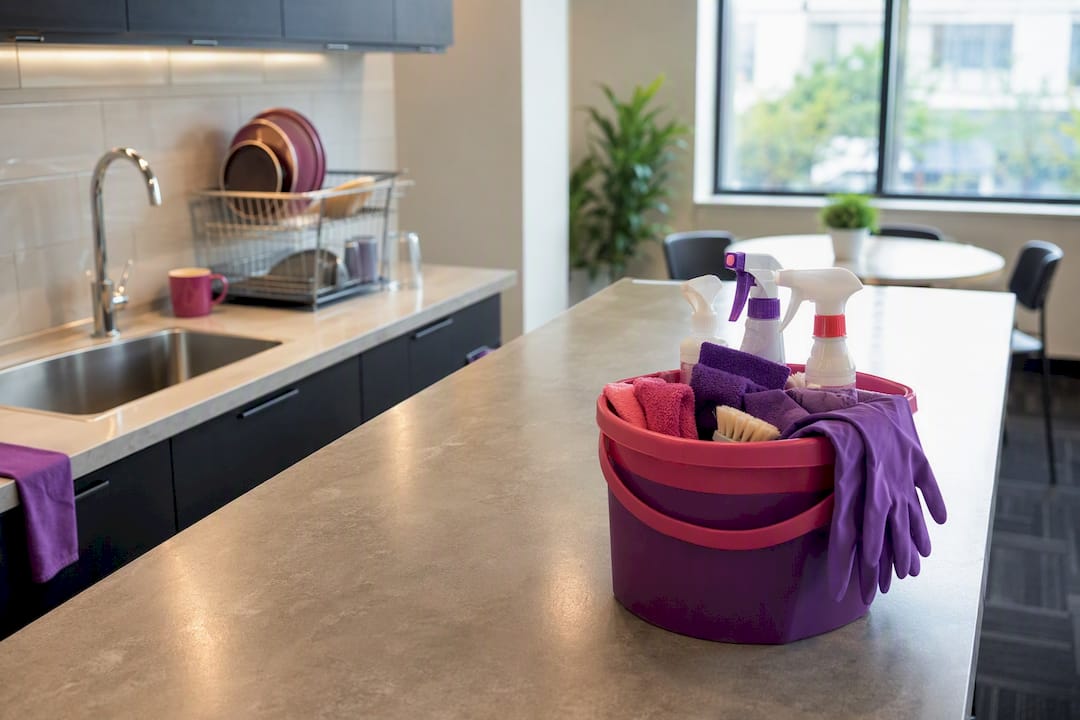
Roster models work reasonably well in smaller offices with low staff turnover, where the same faces cycle through the same simple duties. Once your office grows larger or has higher staff turnover, rosters become harder to maintain and standards may drift without clear accountability. At that point, contracted cleaning for the heavier or daily tasks becomes the more reliable option, freeing staff to handle only the light, immediate jobs like wiping their own space.
Positive reinforcement beats policing. A quick thank-you message or an informal “Kitchen Champion” shout-out does more for compliance than a stern email. For repeat offenders, a simple two-step escalation, a friendly reminder first, then a direct conversation, keeps things proportionate.
Pro Tip: A one-page weekly checklist, signed off by an admin or cleaning monitor, takes two minutes to complete and gives you a paper trail if standards ever slip.
How cold should the office fridge be and how often should it be cleared?
Keep the fridge at or below a safe temperature and verify it with an appliance thermometer rather than trusting the dial, which is often inaccurate. This single check prevents more food safety issues than almost any other kitchen habit.
Run a regular fridge reset on a fixed day. Announce it in advance (a Friday morning email works well) so people have a chance to rescue anything they still want, then discard anything unlabelled or past its date without exception.
Follow gov.uk’s guidance on refrigerating perishables promptly, ideally within two hours of arriving in the kitchen, and treat leftovers as a three or four-day limit, not a “still smells fine” judgement call.
- Store raw items, if any are ever kept, on the bottom shelf to stop drips contaminating food below.
- Keep ready-to-eat food and drinks on higher shelves.
- Label everything with a name and date, no exceptions.
A copy-ready kitchen hygiene policy you can paste into your handbook
Here’s a template built for speed, not decoration. Adjust names and days to match your office.
Purpose statement: “This kitchen is a shared space. Everyone using it is responsible for keeping it clean, safe, and hygienic for colleagues.”
Rules:
- Clean as you go, wipe spills immediately.
- Label all food with name and date.
- Wash your own dishes same day.
- Report low supplies to [named owner].
- No personal items left overnight.
- Fridge purge every [day] at [time]; unlabelled items are binned.
- Report spills or breakages immediately, don’t leave them for someone else.
- Follow COSHH labelling on all cleaning products.
Responsibilities:
- Staff: daily bench wipes, own washing-up, food labelling.
- Admin: weekly fridge reset, supply checks, sign-off checklist.
- Cleaner: high-touch sanitising, monthly deep clean, floor care.
Sample signage: Sink: “Please wash and dry your own mug.” Fridge: “Weekly purge every Friday, 4pm.” Microwave: “Please wipe after use.”
Why professional support keeps the policy running when staff can’t
Sea Light Shine works with offices across East Anglia handling exactly the tasks that rosters struggle to sustain, daily high-touch sanitising, weekly fridge resets, and quarterly deep cleans that catch the grease and grime behind appliances staff rarely touch.
- Consistent standards regardless of staff turnover or holiday gaps.
- Reduced administrative burden, no more chasing a rota that’s stopped working.
- Trained cleaners who already understand COSHH compliance and correct product use.
This article was written by Kate at Sea Light Shine, drawing on the practical realities of maintaining hygiene standards in shared commercial kitchens across the region.
Getting the policy to stick, not just written down
The best change I’ve seen work in practice is deceptively small: a laminated fridge purge sign, taped at eye level on the door, with a day and time printed on it. It removes every excuse. Nobody argues with a date.
Introduce new rules with a friendly all-staff message, not a stern memo, and revisit the code of conduct at every induction. Policies survive on repetition, not paperwork.
— Kate
Book scheduled hygiene cleans that outlast any rota
Rotas fail quietly, someone leaves, a task gets missed, and within a month the kitchen looks nothing like the policy on the wall. Sea Light Shine is the alternative to relying on staff goodwill alone: a scheduled visit, on a fixed day, that happens whether your office is fully staffed or down to half its usual headcount.
Our commercial cleaning contracts cover exactly what this policy demands, high-touch sanitising, fridge resets, and periodic deep cleans, so nothing depends on whoever remembered it was their turn. For offices wanting a dedicated service built around shared kitchens and communal spaces, our office cleaning page outlines what’s included and how scheduling works. Get in touch for a quote and we’ll build a schedule around your kitchen’s actual usage, not a generic template.
Sources
- Gov
- COSHH: control of substances hazardous to health — HSE
- Office kitchen cleanliness: maintaining hygienic shared spaces — Nexus Facility Services