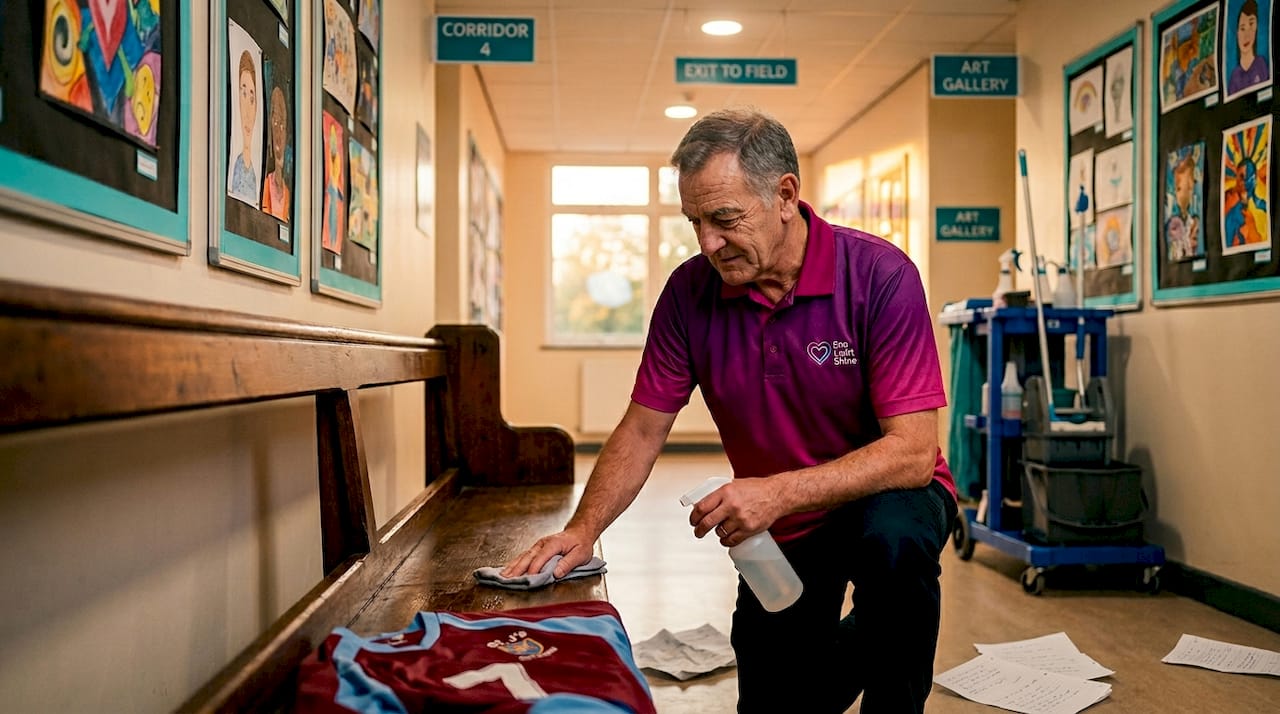
School events bring energy and community together, but what is post-event cleaning on school premises? It is far more than collecting cups and pushing chairs back into rows. It is a structured process covering hygiene restoration, safety checks, surface sanitisation, and the return of shared spaces to full working order before pupils and staff arrive the next morning. Schools face pressures that most venues do not: well-maintained school facilities improve focus and reduce health-related disruptions, making the standard of post-event cleaning a direct factor in pupil wellbeing.
Table of Contents
- Key takeaways
- What is post-event cleaning on school premises?
- Scheduling post-event cleaning around school life
- Professional services and modern technology
- Post-event cleanup checklist for school premises
- What I have learned managing school cleaning after events
- How Sealightshine supports your school after events
- FAQ
Key takeaways
| Point | Details |
|---|---|
| More than tidying | Post-event cleaning addresses hygiene, safety, and full operational restoration, not just visible mess. |
| High-touch surfaces matter | Door handles, switches, and shared equipment need daily disinfection to limit infection spread. |
| Timing is strategic | Aligning deep cleaning with school breaks minimises disruption while maximising thoroughness. |
| Professional services add value | Specialist cleaning providers bring compliance knowledge, consistent standards, and modern equipment. |
| A checklist reduces gaps | A sequential post-event cleanup checklist catches hidden messes that an ad hoc approach misses. |
What is post-event cleaning on school premises?
Post-event cleaning on school premises refers to the full cycle of tasks required to return a school building and its grounds to a safe, hygienic, and operationally ready state after any organised event. That includes sports days, parents’ evenings, open days, fairs, theatre productions, and examinations. Each of these generates a different type of mess, and each carries its own contamination risks.
Standard post-event cleaning tasks cover waste removal, hard surface cleaning, floor care, restroom servicing, and the breakdown of temporary fixtures such as staging, display boards, and catering tables. But the work goes deeper than those visible categories.
Sanitisation of high-touch surfaces
Door handles, light switches, and shared equipment require daily cleaning with approved disinfectants after any period of elevated use. An event multiplies the number of people touching these surfaces by a significant margin, which multiplies microbial transfer. Approved agents include 10% bleach solutions, 70% ethanol, and hydrogen peroxide sprays. Each requires the correct contact time to be effective, and staff must wear appropriate protective equipment throughout.
Sanitary facilities and hidden messes
Toilets and washrooms take disproportionate punishment during school events. Restocking soap, paper towels, and sanitary products is part of the job, but so is scrubbing grout lines, unblocking drains, and removing odour. Hidden messes are the category most often missed by an untrained team: spills that have soaked under display stands, food debris behind temporary furniture, and microbial residue on soft furnishings that dries invisibly but remains active.
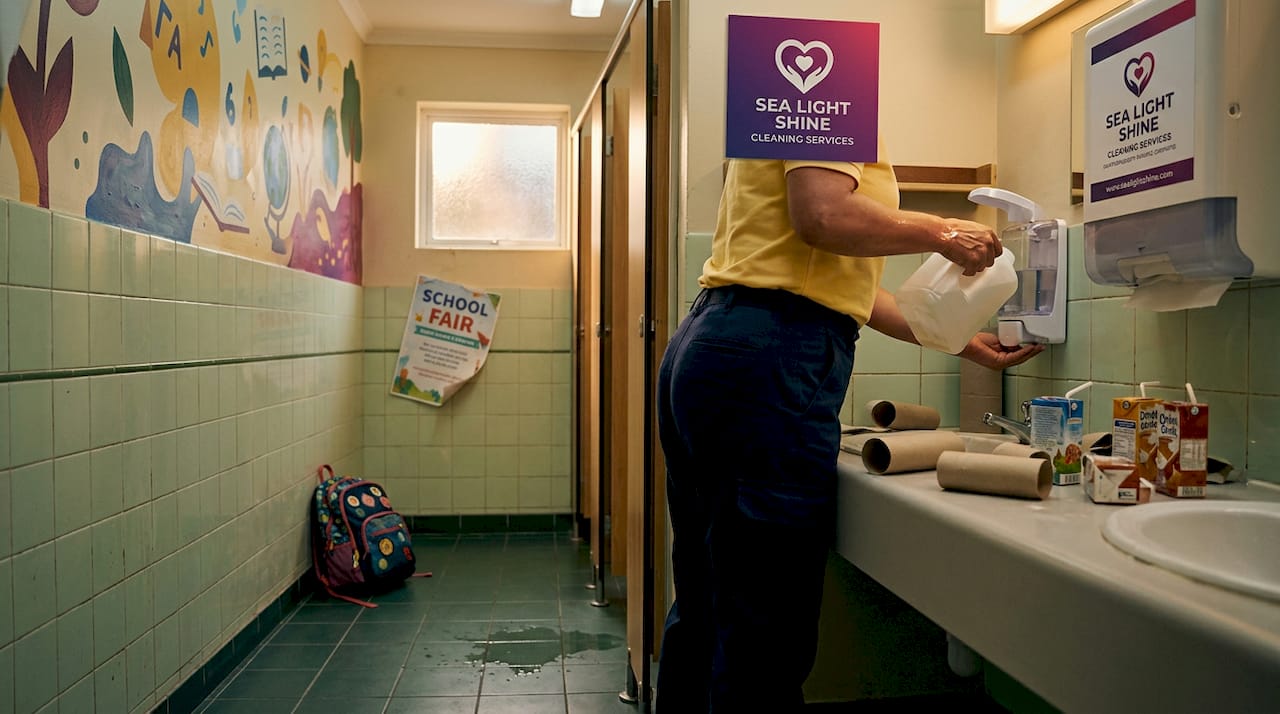
Pro Tip: After an event with catering, lift every table and check underneath before considering the floor clean. Sugary spills attract pests and breed bacteria rapidly, even when dry.
Scheduling post-event cleaning around school life
Timing is one of the more complex parts of post-event maintenance for schools. Clean too early and you are working around guests or performers. Wait too long and you are handing dirty facilities back to pupils the following day.
The table below shows how different timing strategies compare for common school events:
| Scenario | Best approach | Risks if delayed |
|---|---|---|
| Evening parents’ evening | Same-night clean by 10pm | Odours and litter overnight; classrooms unusable by 8am |
| All-day sports day | Rolling clean during event, full reset after | Toilet backlogs; wet floors create slip hazards |
| End-of-term school fair | Next-morning deep clean | Pest attraction from food waste left overnight |
| Holiday-period events | Combine with vacation maintenance | Repairs and deep tasks can be batched efficiently |
Schools are moving towards tailored cleaning programmes aligned with their operational schedules, and this flexibility is where significant improvements are made. A rigid, one-size-fits-all contract simply does not account for the variety of events a modern school hosts throughout the year.
One instructive example comes from Delhi, where MCD directed schools to use summer break for repairs, whitewashing, toilet and water facility maintenance, and debris removal ahead of the new academic session. Combining post-event and post-term cleaning during a closed period is a sensible model that minimises disruption while tackling tasks that cannot be completed safely around pupils.
Pro Tip: Build a cleaning schedule into your event approval process. Before any event is confirmed, assign a cleaning lead, agree a finish time, and block the necessary hours in the facilities calendar. It takes three minutes and prevents hours of reactive scrambling.
Professional services and modern technology
The argument for engaging professional school cleaning services is not simply convenience. It is about compliance, consistency, and capability that an in-house team stretched across routine duties rarely achieves alone.
Specialist post-event cleaning services bring several advantages that matter specifically in educational environments:
- Regulatory knowledge. Professional providers understand COSHH regulations, surface-specific disinfectant requirements, and documentation standards for health and safety audits.
- Robotic floor cleaning. K-12 schools use robotic cleaning for floors to save staff time, improving overall sanitation and safety standards. Autonomous scrubbers cover large hall floors consistently, freeing staff to focus on washrooms, kitchens, and high-touch surfaces where human judgement is irreplaceable.
- Trained chemical application. Correctly timed disinfectant contact, proper dilution ratios, and appropriate protective equipment are standard practice for trained cleaning operatives, not an afterthought.
- Documented outcomes. A professional provider produces completion records and inspection reports. These are useful when a safeguarding review or a health and safety audit asks for evidence of cleaning standards.
The shift towards eco-friendly school cleaning methods also sits more comfortably with professional providers who have invested in low-chemical cleaning technology and sustainable products. For schools with environmental commitments in their policies, this matters.
Post-event cleanup checklist for school premises
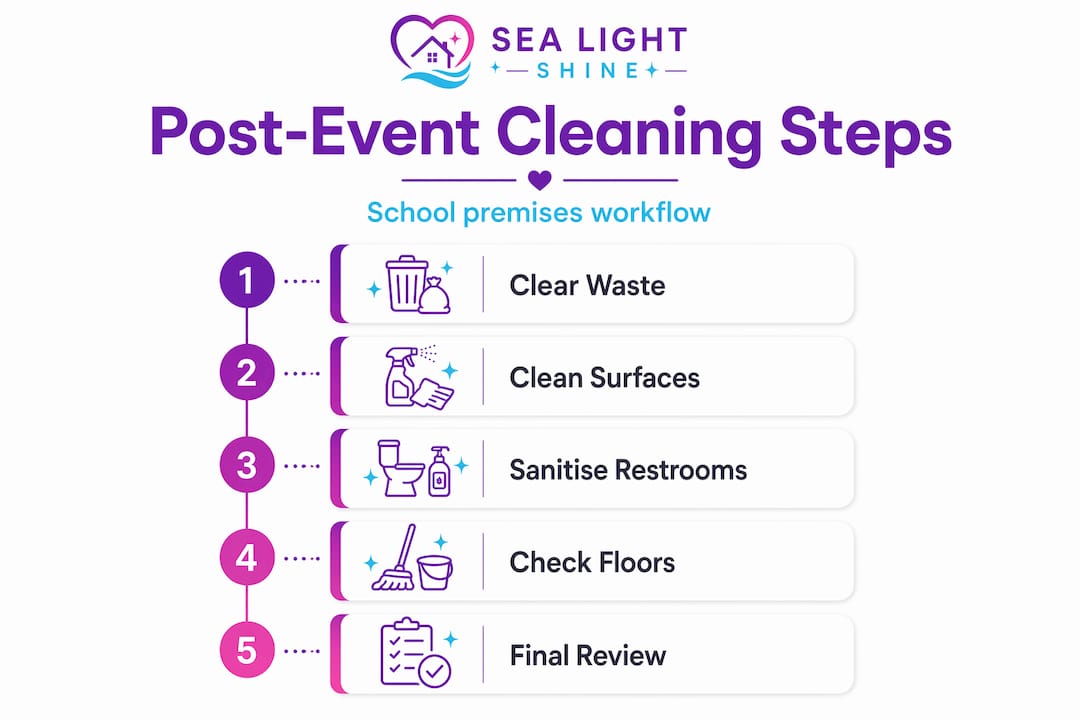
Effective school event cleaning procedures follow a logical sequence. Moving through tasks in the wrong order wastes time. For example, mopping floors before removing furniture means mopping again. The following numbered sequence reflects best practice for a full post-event reset:
- Cordon off any hazardous areas such as wet floors, broken furniture, or spillages requiring specialist treatment.
- Remove all temporary structures, including staging, display boards, signage, and catering equipment.
- Collect and sort all waste. Separate general waste, recyclables, and food waste before bagging and removing.
- Vacuum or sweep all floor areas before any wet cleaning begins, working from the furthest point back to the exit.
- Mop hard floors with an appropriate cleaner, paying particular attention to under-furniture residue and entrance matting.
- Clean and disinfect all high-touch surfaces: door handles, handrails, light switches, toilet flush handles, and taps.
- Service all sanitary facilities: clean, disinfect, restock, and check drainage.
- Return furniture and equipment to standard classroom or hall layout according to a floor plan.
- Check windows, blinds, and display areas for fingerprints, smudges, and residue.
- Final walkthrough inspection with a supervisor signing off each area against the checklist.
| Area | Key tasks | Completion sign-off |
|---|---|---|
| Main hall or sports hall | Floor clean, stage breakdown, seating reset | Yes / No |
| Classrooms used by guests | Desk reset, surface wipe, floor clean | Yes / No |
| Corridors and entrances | Litter removal, floor clean, matting check | Yes / No |
| Toilets and washrooms | Full clean, disinfection, restock | Yes / No |
| Kitchen or catering areas | Surface clean, waste removal, equipment storage | Yes / No |
Following the checklist format for cleaning after school events removes the reliance on individual memory and creates an auditable record. That record matters when a parent, governor, or inspector asks about cleaning standards.
What I have learned managing school cleaning after events
I have worked with schools across East Anglia long enough to know that post-event cleaning is where most cleaning contracts quietly fall apart. The problem is rarely the routine. It is the exceptions. A scheduled clean at 6am looks fine on paper until a Year 9 talent show finishes at 9pm and leaves the hall covered in glitter, spilled energy drinks, and dismantled scenery.
The single biggest mistake I see is treating event cleaning as an extension of daily cleaning rather than a separate operational task. It is not. The volume, the variety of surfaces affected, and the time pressure are all different. Administrators who understand this build event cleaning into the planning process from the start, not as an afterthought when the caretaker is already exhausted.
Managing a school cleaning contract effectively means building explicit clauses for post-event scenarios, agreed response times, and defined scope. The schools I have seen handle this well share one habit: they communicate with their cleaning provider at least two weeks before any significant event, not the night before.
Poor communication and rigid schedules in cleaning contracts cause service gaps that affect school environments directly. That is not just frustrating. It creates genuine risk. A floor not cleaned after a catering event is a slip hazard. A toilet block not restocked after a parents’ evening is a safeguarding embarrassment. These are not minor issues.
— Kate
How Sealightshine supports your school after events
Sealightshine provides reliable, professional post-event cleaning services to schools and educational facilities across East Anglia. Whether you need a same-night reset after a parents’ evening or a comprehensive deep cleaning service following an end-of-term event, our trained operatives work to a documented standard with the products and equipment to match. We understand school schedules, safeguarding requirements, and the pressure to have everything ready before the first pupils arrive. Explore our school cleaning services or contact Sealightshine today to discuss a cleaning plan built around your events calendar.
FAQ
What does post-event cleaning at a school involve?
Post-event cleaning at a school covers waste removal, floor cleaning, surface disinfection, sanitary facility servicing, and furniture restoration. It goes beyond basic tidying to address hygiene, safety, and full operational readiness.
How soon after a school event should cleaning begin?
Cleaning should begin as soon as the event space is clear of guests, ideally the same evening. Leaving waste and spills overnight increases pest risk, odour, and slip hazards before the school day begins.
Why are high-touch surfaces a priority after school events?
High-touch surfaces such as door handles and shared equipment carry concentrated microbial transfer during high-footfall events. Disinfecting them immediately after an event significantly reduces infection risk for pupils and staff.
Can schools use holiday periods for post-event and deep cleaning?
Yes. Combining post-event maintenance with school holidays is an efficient approach. Delhi’s MCD directed schools to use summer breaks for repairs, toilet maintenance, and debris removal, demonstrating how batched cleaning during closed periods reduces disruption.
When should a school use professional post-event cleaning services?
A school should use professional cleaning services when events involve catering, large audiences, or specialist equipment, or when in-house staff lack the time, training, or products to restore the premises to a safe standard before the next school day.