

Managing a school cleaning contract is rarely as straightforward as signing on the dotted line. Many school administrators across East Anglia face the same recurring frustrations: missed cleans, vague responsibilities, and suppliers who perform brilliantly during the tender process but fade once the contract begins. Knowing the right ways to manage a school cleaning contract, from specification writing to supplier audits and digital performance tracking, is what separates schools that maintain consistent hygiene standards from those that are scrambling before an Ofsted visit.
Table of Contents
- Ways to manage school cleaning contracts: start with clear requirements
- Preparing for contract execution: supplier audit and site assessment
- Managing contract delivery: communication, quality checks and issue tracking
- Scheduling periodic and deep cleans to maintain long-term standards
- Handling common pitfalls and ensuring inspection readiness
- Why most school cleaning contracts fail without proactive management
- Enhance your school cleaning contracts with Sea Light Shine
- Frequently asked questions
Key Takeaways
| Point | Details |
|---|---|
| Clear contract details | Specify task types, frequency, and quality standards precisely in the cleaning contract. |
| Pre-tender site audits | Assess specialist areas and supplier capabilities before awarding contracts to avoid issues. |
| Regular performance reviews | Hold monthly meetings and quarterly audits to monitor and improve service quality. |
| Use digital tracking | Implement digital logging with photo proof to prevent unreported cleaning lapses. |
| Schedule deep cleans | Ensure periodic and holiday deep cleans are clearly scheduled and tracked to maintain hygiene. |
Ways to manage school cleaning contracts: start with clear requirements
To effectively manage your contract, begin by understanding and specifying your school’s unique cleaning needs in precise terms. A well-written specification is your single greatest tool. Without it, every dispute becomes a matter of interpretation rather than fact.
A strong school cleaning contract should set out exactly what is required, where, how often, and to what standard. That means going area by area: classrooms, corridor floors, washrooms, science labs, sports halls, and kitchens each carry different hygiene demands and should be listed separately.
Key elements your contract specification must include:
- Daily and weekly cleaning tasks listed by room type and frequency
- Periodic tasks such as floor scrubbing, high-level dusting, and washroom descaling
- Safeguarding requirements including DBS checks for all cleaning staff
- Named contract manager with clearly defined supervisory responsibilities
- Mobilisation timeline and TUPE transfer arrangements for incoming staff
- Quality standards against which performance will be measured and reported
Use a cleaning contract checklist to ensure nothing is left to assumption during the drafting phase.
| Area | Daily tasks | Periodic tasks | Frequency |
|---|---|---|---|
| Classrooms | Vacuuming, surface wipe, bins | Deep carpet clean | Termly |
| Washrooms | Disinfect fixtures, mop floors | Descaling, grout clean | Monthly |
| Science labs | Surface sanitise, bin removal | Full equipment wipe | Weekly |
| Sports halls | Sweep floors, spot clean | Floor scrub, mat clean | Half-termly |
| Corridors | Mop, bins, spot clean | High-level dusting | Monthly |
Pro Tip: Ask your supplier to provide a written mobilisation plan before the contract starts. This document should name every member of staff assigned to your site, their DBS status, and their start date. Suppliers who cannot produce this are telling you something important about their internal processes.
Schools with a focus on safe eco-friendly cleaning should also specify product requirements at this stage, particularly for rooms used by younger pupils or those with allergies.
Preparing for contract execution: supplier audit and site assessment
Once your requirements are clear, thorough supplier vetting and a pre-tender site assessment ensure you award the contract to the right partner and avoid unexpected costs down the line.
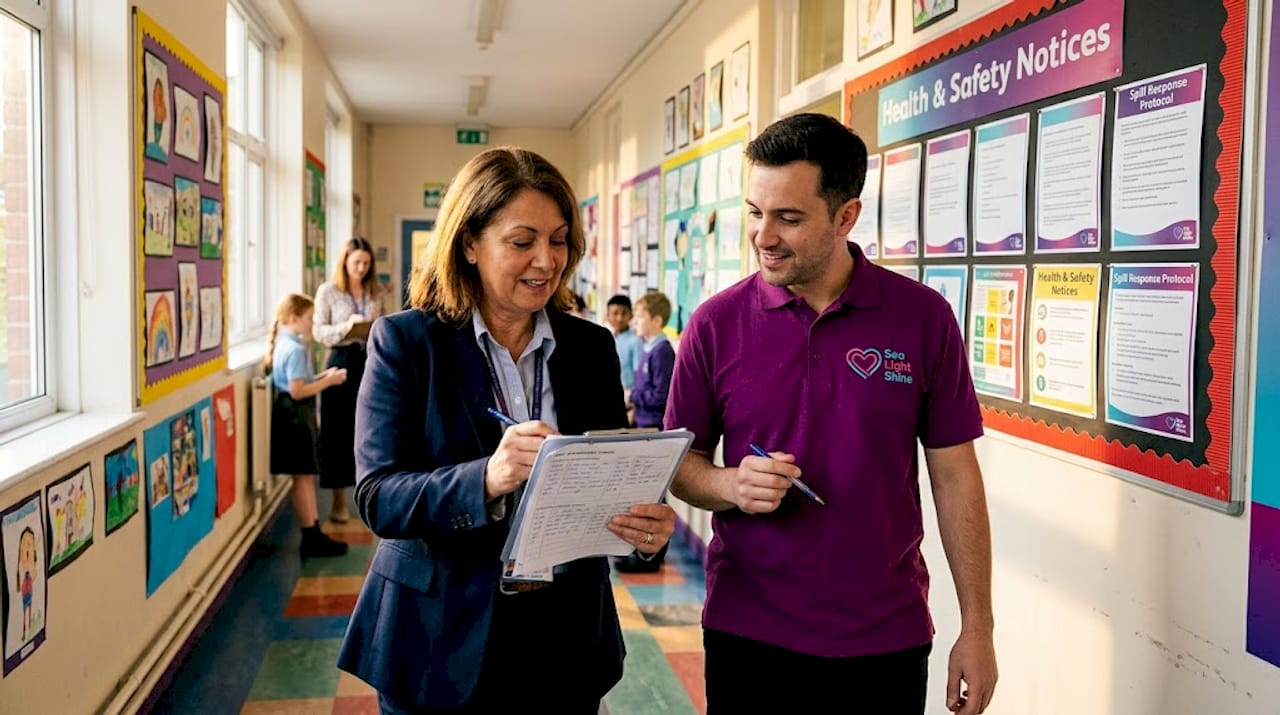
Schools across East Anglia must recognise that pre-tender site reviews prevent cost overruns and missed requirements, particularly in specialist areas like laboratories and fitness suites. A supplier who has never walked your site is guessing at the scope of work, and that guess becomes your problem once the contract starts.
Steps to conduct a thorough pre-award assessment:
- Walk every area of the building with prospective suppliers, including storage rooms and rarely visited spaces
- Ask each supplier to submit a site-specific cleaning schedule, not a generic template
- Request evidence of DBS check procedures and confirm their timeline for compliance
- Assess how each supplier manages staffing, supervision, training, absence cover, and issue resolution
- Confirm their mobilisation plan including TUPE provisions if existing staff are affected
- Establish escalation routes: who do you call at 7am if a team member fails to show?
A useful exercise is to ask suppliers how they have handled a previous service failure. The quality of that answer tells you far more than their brochure ever will.
| Evaluation criterion | What to look for | Red flags |
|---|---|---|
| DBS compliance | Written policy with timeline | Vague assurances |
| Absence cover | Named backup staff | “We’ll sort it on the day” |
| Supervision | Named daily supervisor | “The team self-manages” |
| Technology | Digital task logging | Paper-only checklists |
| Training | Written schedule and records | Training described verbally only |
Use a detailed cleaning contract checklist during supplier evaluation to compare proposals objectively. Schools preparing for Ofsted inspections will also benefit from reviewing what Ofsted-ready cleaning standards look like in practice before awarding any contract.
Pro Tip: Request a site-specific risk assessment from each tenderer, not a generic health and safety document. A supplier who understands your laboratory ventilation requirements and wet-floor risks for pupils is a supplier who has genuinely thought about your site.
Managing contract delivery: communication, quality checks and issue tracking
With the contract underway, proactive communication and consistent quality checks keep standards high and problems resolved before they escalate.
Effective school cleaning contracts require regular performance reviews including monthly meetings, logged issue tracking, and quarterly supplier audits. Monthly meetings should not simply be a courtesy call. Arrive with documented questions, a record of any missed or substandard cleans, and a clear agenda.
“A cleaning issue that is not logged is a cleaning issue that will recur.” This is the most reliable rule in facilities management. If a problem is not written down, tracked, and responded to, it simply becomes part of the building’s baseline.
Your monthly review meeting should cover:
- Outstanding issues from the previous meeting with documented resolutions
- Attendance and DBS compliance updates for any new or substitute staff
- Review of digital task logs and any photo evidence of problem areas
- Upcoming term dates and changes to cleaning schedules
- Any planned deep cleans or periodic tasks due in the coming weeks
Contracts without digital logging lead to untracked repeat issues; manual checklists fail 40% of the time compared to app-based systems with photo proof. Insist on digital logging from day one. Tools that require staff to photograph completed tasks before marking them done create an automatic audit trail. That trail protects both parties if a dispute arises.
Quarterly audit checklist:
- Conduct an unannounced inspection of at least three areas per floor
- Cross-reference findings with the supplier’s own task logs
- Review staff attendance records against scheduled cleaning hours
- Confirm DBS checks remain current for all active staff
- Score performance against the agreed quality standards in your specification
Good contract cleaning management requires you to be a visible, engaged client. Suppliers serve attentive clients better. That is simply human nature. Facilities managers who are rarely seen allow standards to drift, whereas those who conduct regular walkthroughs signal that quality genuinely matters.
Schools prioritising a safe learning environment should also track whether cleaning products and methods remain aligned with the original specification throughout the contract term, not just at the point of award.
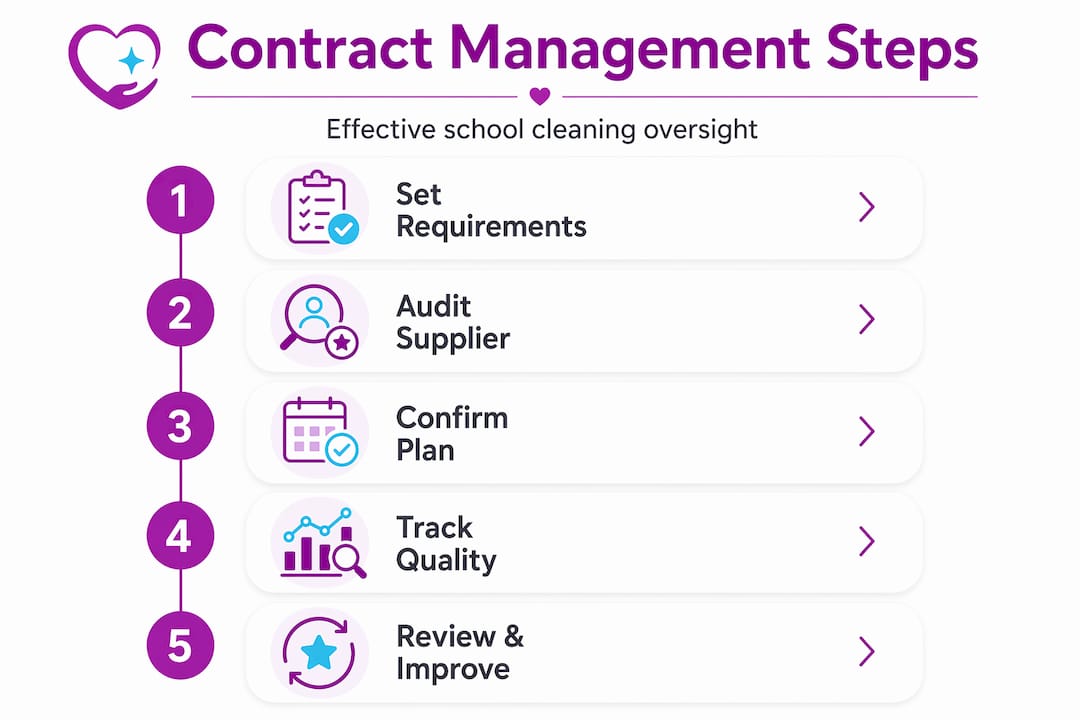
Pro Tip: Create a shared issue log accessible to both your facilities team and the supplier’s contract manager. When both parties can see the same live document, there is no room for “we didn’t know about that” responses.
Scheduling periodic and deep cleans to maintain long-term standards
Alongside daily upkeep, scheduling and verifying periodic deep cleans preserves building quality and keeps you prepared for inspections.
One of the most common pitfalls in UK schools is overlooking scheduled holiday deep cleans, which risks contractors skipping them entirely and creates Ofsted non-compliance risks. The reason this happens is straightforward: if deep cleans are not explicitly scheduled in the contract with named dates, suppliers have no obligation to perform them and no incentive to volunteer.
Periodic cleaning tasks that must be specified explicitly:
- Floor scrubbing and machine polishing in corridors and halls
- High-level dusting of ceiling fixtures, vents, and light fittings
- Washroom descaling and grout cleaning
- Window cleaning (internal and external where accessible)
- Deep clean of kitchen areas including extraction units
- Carpet and upholstery extraction in staffrooms and offices
Schedule deep cleans during half-term breaks and summer holidays when the building is empty. This allows cleaning teams to work without disruption and ensures thoroughness that simply is not possible during term time. Track completion of these tasks with the same rigour as daily duties, including photo evidence and sign-off.
| Contract type | Daily cleaning included | Periodic cleans included | Holiday deep cleans | Risk level |
|---|---|---|---|---|
| Basic contract | Yes | Not specified | No | High |
| Standard contract | Yes | Listed but unscheduled | Rarely | Medium |
| Full-specification contract | Yes | Scheduled with dates | Yes, confirmed in advance | Low |
Refer to a detailed deep cleaning guide to understand exactly what tasks should be included at each interval. Use cleaning checklists as a starting template and adapt them for the specific demands of your school building.
Pro Tip: Build a cleaning calendar into your contract and share it with governors or trustees. When periodic cleans are visible at board level, they are far less likely to be skipped without consequence.
Handling common pitfalls and ensuring inspection readiness
By anticipating and preventing common contract weaknesses, schools can maintain hygiene consistency and be genuinely prepared when inspectors arrive.
The data here is clear: visible daily quality checks and named supervisors prevent 80% of common service failures. Yet many contracts still use vague language like “supervision will be provided as appropriate.” That phrase means nothing and protects nobody.
Common pitfalls and how to address them:
- Vague supervision clauses: Replace with named supervisors and written daily inspection requirements
- Undocumented DBS checks: Require a live register of all cleaning staff with check dates and renewal schedules
- No escalation path: Define a named escalation contact at the supplier for out-of-hours emergencies
- Infrequent audits: Commit to at least quarterly unannounced inspections and document outcomes
- No audit trail: Insist on digital task completion logs with timestamps and photo evidence
- Inspection preparation left to chance: Maintain a cleaning compliance folder updated monthly for Ofsted readiness
For inspection readiness, your documentation should demonstrate a clear, continuous record of cleaning performance. An inspector asking to see evidence of your cleaning management should be met with a folder, not a shrug.
Revisit your contract management checklist quarterly to confirm your contract and your practices remain aligned. For a broader view of why professional cleaning standards matter beyond compliance, professional cleaning benefits for East Anglia organisations are well documented.
Pro Tip: Run an internal mock inspection twice a year. Walk your building with the same focus an Ofsted inspector would apply to cleanliness and hygiene. Any gap you spot is a gap you can close before it counts.
Why most school cleaning contracts fail without proactive management
Here is the uncomfortable truth about school cleaning contracts: most of them are not bad contracts. They are badly managed ones.
A school cleaning service is only as reliable as the management behind it, and the most common weaknesses are a lack of clear supervision, reporting, and escalation processes. We have seen schools with exceptionally well-written contracts that still struggled with inconsistent cleaning simply because nobody on the school side was actively reviewing performance. The supplier filled the vacuum with minimal effort.
The assumption that a contract enforces itself is one of the most expensive mistakes a facilities manager can make. Contracts create obligations. People and processes enforce them. Without a named person on your side who owns the supplier relationship, conducts walkthroughs, chairs monthly meetings, and escalates issues promptly, even the best specification becomes decorative.
Digital tools are not optional. They are the difference between a performance conversation grounded in evidence and one based on memory and goodwill. When a supplier knows that every task is logged and every completion photographed, the standard of work rises. That accountability is not punitive; it is structural.
The schools we see maintaining the highest cleaning standards are not necessarily those with the biggest budgets. They are the ones where the facilities manager is engaged, visible, and consistent. They review their reliable cleaning contract checklist regularly. They treat their supplier as a partner, not a vendor to ignore until something goes wrong. That posture is what turns a contract into a genuinely functional service.
Invest the time at the front end. Set the specification precisely, audit the supplier thoroughly, build the reporting mechanisms before the first clean happens, and you will spend far less time firefighting throughout the contract term.
Enhance your school cleaning contracts with Sea Light Shine
Managing all of this alongside your other responsibilities is a considerable undertaking. That is precisely why choosing the right cleaning partner matters as much as how you manage the contract itself.
Sea Light Shine’s commercial cleaning services are built around the standards East Anglia schools actually need: trained staff, documented DBS compliance, digital task logging, and the kind of consistent supervision that makes contract management genuinely easier. Whether you need daily cleaning, holiday deep cleaning services, or a fully managed professional school cleaning programme, Sea Light Shine delivers reliable, inspection-ready results. Reducing your management burden starts with choosing a supplier who understands accountability from day one.
Frequently asked questions
How often should a school hold cleaning contract performance reviews?
Monthly performance meetings and quarterly supplier audits are the recommended minimum to maintain cleaning standards and address issues before they become patterns.
Why are digital logging systems important in managing school cleaning contracts?
Manual checklists fail up to 40% of the time compared to app-based systems, meaning digital logging with photo proof is the only reliable way to confirm tasks are genuinely completed.
What must be included to ensure deep cleans are not overlooked?
Periodic and holiday deep-cleaning tasks must be named, dated, and written into the contract explicitly, not left as implied obligations, to ensure they are both performed and verifiable.
What key checks should be conducted before awarding a cleaning contract?
Pre-tender site reviews of specialist areas, combined with supplier assessments covering staffing, DBS checks, absence cover, and supervision arrangements, are essential before any contract is awarded.
How can schools maintain hygiene standards during staff absences?
Contracts must specify absence cover arrangements, named deputies, and clear supervisor responsibilities so that cleaning quality does not depend on any single individual turning up on any given day.


