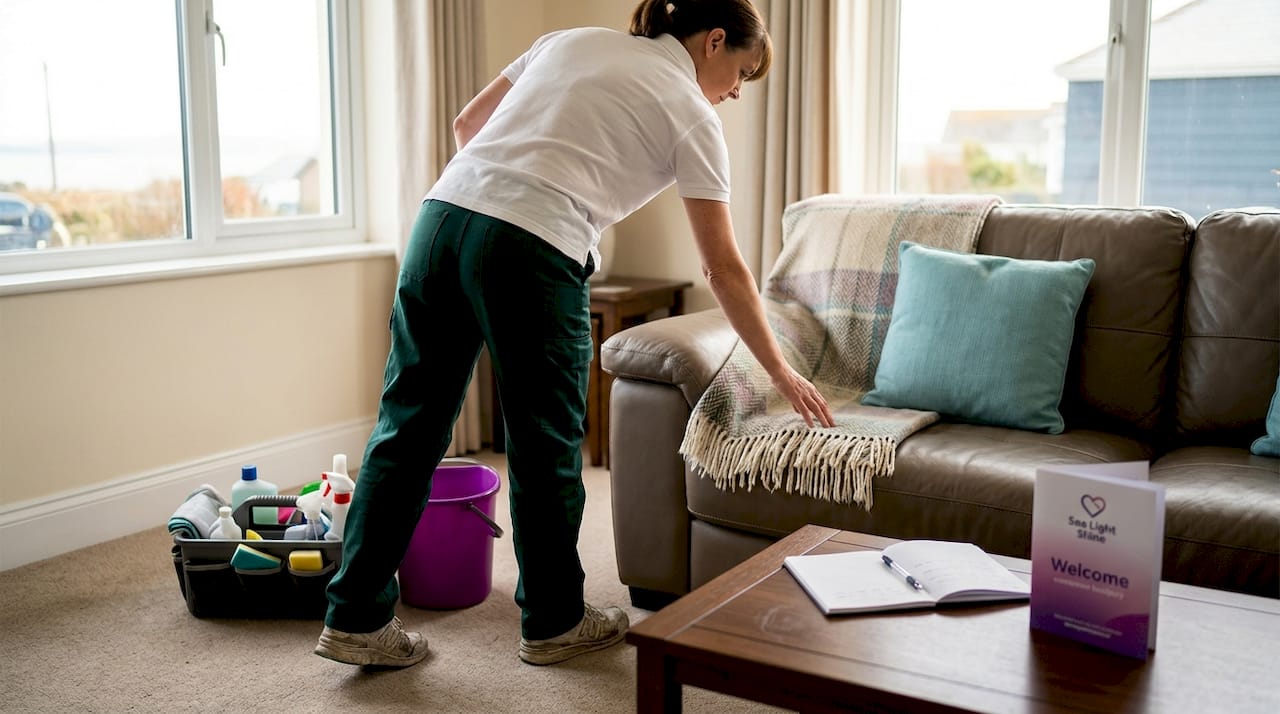
Most holiday let owners assume a quick tidy between guests is enough. It is not. Understanding how holiday let cleaning frequency works is one of the most underrated factors in protecting your property, securing five-star reviews, and staying on the right side of health and safety regulations. Get it wrong and you will see the consequences in your ratings before you see them in your inspection reports. Get it right and guests will notice, even if they cannot quite explain why.
Table of Contents
- Key takeaways
- What holiday let cleaning frequency means in practice
- Realistic timeframes and turnover challenges
- When to increase cleaning frequency
- Building a cleaning schedule that actually works
- Understanding the costs of cleaning frequency
- My take on where owners go wrong
- How Sealightshine can help you manage this
- FAQ
Key takeaways
| Point | Details |
|---|---|
| Turnover cleans are non-negotiable | Every guest departure requires a full reset clean, not just a surface tidy. |
| Deep cleans must be scheduled | Monthly or quarterly deep cleans prevent hygiene build-up that turnover cleans miss entirely. |
| Time buffers protect your ratings | Building buffer time between check-out and check-in prevents rushed cleans and late arrivals. |
| Frequency depends on your booking pattern | High-occupancy properties need more frequent deep cleans than low-season lets. |
| Automation removes coordination errors | Linking cleaning tasks to booking events dramatically improves schedule reliability. |
What holiday let cleaning frequency means in practice
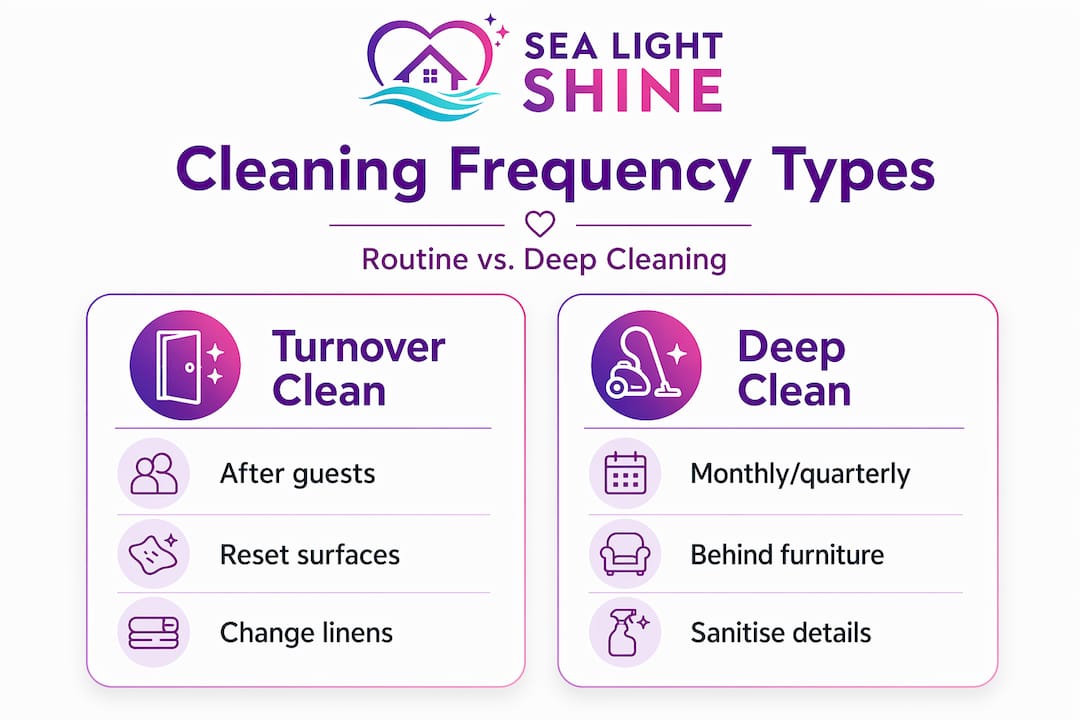
The term “cleaning frequency” covers two distinct cleaning types that serve very different purposes. Confusing them is where most owners run into trouble.
A turnover clean (also called a changeover clean) happens after every single guest departure. Its purpose is a complete reset: fresh linen, sanitised surfaces, restocked consumables, and a property that looks and smells exactly as it did when the first guest arrived. This is your most frequent cleaning task, and its timing is dictated entirely by your booking calendar.
Deep cleaning operates on a different cycle. Monthly or quarterly deep cleans are recommended for most properties, with heavily booked lets needing monthly attention. This is where grout gets scrubbed, ovens get properly degreased, extractor fans get cleared, and the areas no standard turnover reaches are fully addressed.
Several factors shape how often you need each type:
- Property size. A larger property accumulates wear faster and takes significantly longer to clean at every stage.
- Guest volume and booking density. Back-to-back bookings leave no room for anything beyond a tight turnover clean, meaning deep cleans must be deliberately scheduled around gaps.
- Seasonality. Peak summer periods in coastal locations, for example, often mean daily or near-daily turnovers with very little downtime for deeper work.
- Guest behaviour. Families with young children and pet-friendly bookings tend to require more intensive cleaning than adult-only short stays.
There is also a compliance dimension that many owners overlook. Holiday let hosts in England are legally responsible for health and safety compliance, including fire risk assessments and gas and electrical checks. Your cleaning protocols directly affect your ability to meet those standards. A property that is not properly maintained is not just a guest experience problem. It is a liability.
Realistic timeframes and turnover challenges
Knowing how long a proper clean takes is one of the most useful pieces of operational knowledge you can have. Many owners underestimate it badly, and that underestimation causes cascading problems.
Standard turnover cleaning times break down roughly as follows:
| Property size | Typical turnover time |
|---|---|
| Studio | 45–60 minutes |
| 1-bedroom | 60–90 minutes |
| 2-bedroom | 90–120 minutes |
| 3-bedroom or larger | 2–3 hours |
| Large luxury property | 5–10 hours |
These are realistic estimates for a thorough clean, not a rushed once-over. And they assume the cleaner arrives on time, the previous guests checked out punctually, and no unexpected mess is waiting.
A proper turnover clean covers stripping and replacing all bed linen, sanitising every bathroom surface and kitchen contact point, restocking toiletries and kitchen consumables, checking for damage, and completing a final walkthrough inspection. A logical sequence matters: strip and ventilate first, tackle bathrooms and kitchen next, then move through bedrooms and living areas, finish with floors, and close with a full inspection.

The real operational challenge is not the cleaning itself. It is the window you have to do it in. Hard guest check-in deadlines create zero tolerance for delays, and cleaning managers consistently identify buffer time as non-negotiable. If your check-out is at 10am and check-in is at 3pm, you have five hours for cleaning, inspection, and any minor touch-ups. A 2pm check-out with a 3pm check-in is simply not workable for anything larger than a studio.
Same-day bookings make this worse. When a guest books for the same day as a departing stay, you have almost no flexibility, and professional cleaners will typically charge rush fees to accommodate that.
Pro Tip: Confirm with your cleaner the night before any same-day turnover that the booking is live and the timing is agreed. Last-minute miscommunication is the single most common cause of delayed check-ins.
When to increase cleaning frequency
Not every holiday let has the same demands, and understanding when to shift your cleaning routine is what separates reactive owners from proactive ones.
During peak season, a coastal cottage in Suffolk or Norfolk might turn over every two to three days with barely a gap between guests. That kind of density has two consequences. Your turnover clean needs to be highly systematised because there is no time for improvisation, and your deep clean schedule needs to be protected rather than perpetually deferred.
Here is when you need to think about increasing your cleaning frequency or scope:
- Longer stays. Guests staying five nights or more benefit from a mid-stay clean. This keeps hygiene standards up, reduces the load on the final turnover clean, and is increasingly expected by guests paying premium rates for a full week.
- Pet-friendly bookings. Dog hair works its way into soft furnishings and carpets in ways that a standard turnover clean will not fully address. These bookings warrant an enhanced cleaning scope or a more frequent deep clean rotation.
- High occupancy periods. If your property is occupied for more than 20 nights in a single month, you should schedule a deep clean at the end of that month regardless of whether it looks obviously necessary.
- Post-event stays. Bookings tied to weddings, festivals, or family gatherings almost always leave a property in a heavier state than a standard leisure break.
Guest checkout compliance also affects cleaning demands more than owners typically expect. Guests who follow checkout instructions, strip their beds, remove rubbish, and leave the kitchen tidy cut turnover time noticeably. Guests who do not can add 30 to 45 minutes to the same clean. Clear, friendly checkout instructions in your welcome pack are worth their weight in avoided rush fees.
A ‘reset’ mindset applied to every turnover, and genuine periodic deep cleaning applied to the areas that accumulate hidden grime, is what keeps properties passing inspections and generating repeat bookings.
Building a cleaning schedule that actually works
A cleaning schedule is not a rota. It is an operational system, and systems need structure to hold up under pressure.
- Set firm check-out and check-in times. This is the foundation. Without consistent times, you cannot plan cleaning windows reliably. Most professional operators use 10am check-out and 4pm check-in as a starting point, adjusting based on property size and cleaner capacity.
- Use property management software. Automation links cleaning task assignment directly to reservation events, removing the need for manual coordination and eliminating the errors that come with it. When a booking is confirmed or a checkout is logged, your cleaner receives the assignment automatically.
- Plan your deep clean calendar in advance. Do not leave deep cleans to chance gaps. Book them into your calendar at the start of each season and treat them as fixed appointments. For a high-volume summer let, that might mean one deep clean in May before the season opens, one in July mid-season, and one in September to close.
- Use checklists and photo verification. A cleaning checklist for vacation rentals removes ambiguity for your cleaner and gives you a consistent quality baseline. Photo verification at the end of each clean creates a record that protects both you and your cleaner if a guest raises a complaint.
- Communicate clearly with guests and cleaners. Send checkout reminders 24 hours before departure. Brief new cleaners on the property layout and any recurring issues. The more information everyone has, the fewer last-minute surprises you absorb.
Pro Tip: Build a 30-minute buffer into every cleaning window, regardless of property size. It sounds like unnecessary slack until the day a guest leaves the oven in a state or a linen supplier delivers late.
Understanding the costs of cleaning frequency
Cleaning costs are not fixed, and understanding how they move helps you budget accurately rather than being caught off guard.
The national median cleaning fee is around £175 in 2026, but this varies widely by property size, location, and cleaning type. A studio turnover clean is a very different cost proposition from a full deep clean of a five-bedroom coastal property.
Key cost factors to plan for:
- Peak season surges. During high-demand periods, cleaning fees increase by 15 to 25%, and same-day turnovers carry additional rush fees. If your peak season runs from June through August, factor those uplifts into your nightly rate calculations.
- Deep clean budgets. Deep cleans cost more than turnover cleans, typically 1.5 to 2 times the standard fee for the same property. Budget for at least two to three per year as a baseline, more if your occupancy is high.
- Unexpected cleaning. Post-damage cleans, heavy soiling, or missed scheduled cleans that result in catch-up work all add unplanned cost. A small contingency fund of 10 to 15% of your annual cleaning spend is a sensible buffer.
Setting a transparent cleaning fee in your listing that reflects your actual costs, rather than undercharging to compete on price, protects your margins and sets honest guest expectations.
My take on where owners go wrong
I have worked with enough holiday let owners to see the same patterns repeat. The most common mistake is treating a turnover clean like a domestic tidy. They are not the same thing. A domestic clean happens when you live in a space and have context for what has moved, what needs attention, and what is fine. A turnover clean happens under time pressure in a property that has just hosted strangers for several days. That requires a system, not instinct.
The second mistake is perpetually deferring deep cleans. I have seen owners skip scheduled deep cleans for an entire season and then wonder why a routine inspection reveals mould around the bath seal or grease build-up in the extractor that the previous 40 guests apparently failed to notice. Guests notice. They just do not always tell you directly. They tell their review.
What actually works is treating your holiday let cleaning routine as a non-negotiable operational cost rather than a variable you adjust when margins feel tight. Owners who invest in quality cleaning at the right frequency consistently outperform those who cut corners, both in ratings and in repeat bookings. The maths is not complicated.
— Kate
How Sealightshine can help you manage this
If managing your holiday rental cleaning schedule feels like a second job, it does not have to be.
Sealightshine provides professional holiday let cleaning services across East Anglia, covering everything from rapid turnover cleans to thorough periodic deep cleaning tailored to your property size and booking pattern. Our team understands the operational realities of short-term lets. We work to your check-out and check-in windows, use checklists and photo verification as standard, and communicate clearly so you are never left guessing. Whether you manage a coastal cottage in Felixstowe or a larger property in Suffolk, Sealightshine brings the reliability and consistency that holiday letting demands.
FAQ
What is the difference between a turnover clean and a deep clean?
A turnover clean resets the property after each guest departure, covering linen changes, surface sanitisation, and restocking. A deep clean tackles hidden grime, fixtures, and built-up soiling on a monthly or quarterly basis.
How often should I schedule a deep clean for my holiday let?
Monthly or quarterly deep cleans are recommended for most properties. If your property is heavily booked, a monthly deep clean will protect hygiene standards and prevent issues building up between turnovers.
How long does a holiday let turnover clean take?
Cleaning times range from 45 minutes for a studio to two to three hours for a three-bedroom property. Larger luxury properties can require five to ten hours for a full turnover.
Do I need a mid-stay clean for longer bookings?
Yes, for stays of five nights or more, a mid-stay clean maintains hygiene and reduces the intensity of the final turnover clean. It is also increasingly expected by guests booking at premium rates.
Can I automate my holiday let cleaning schedule?
Yes. Property management software can trigger cleaning task assignments automatically when a checkout or new booking is confirmed, removing manual coordination and reducing the risk of scheduling errors.