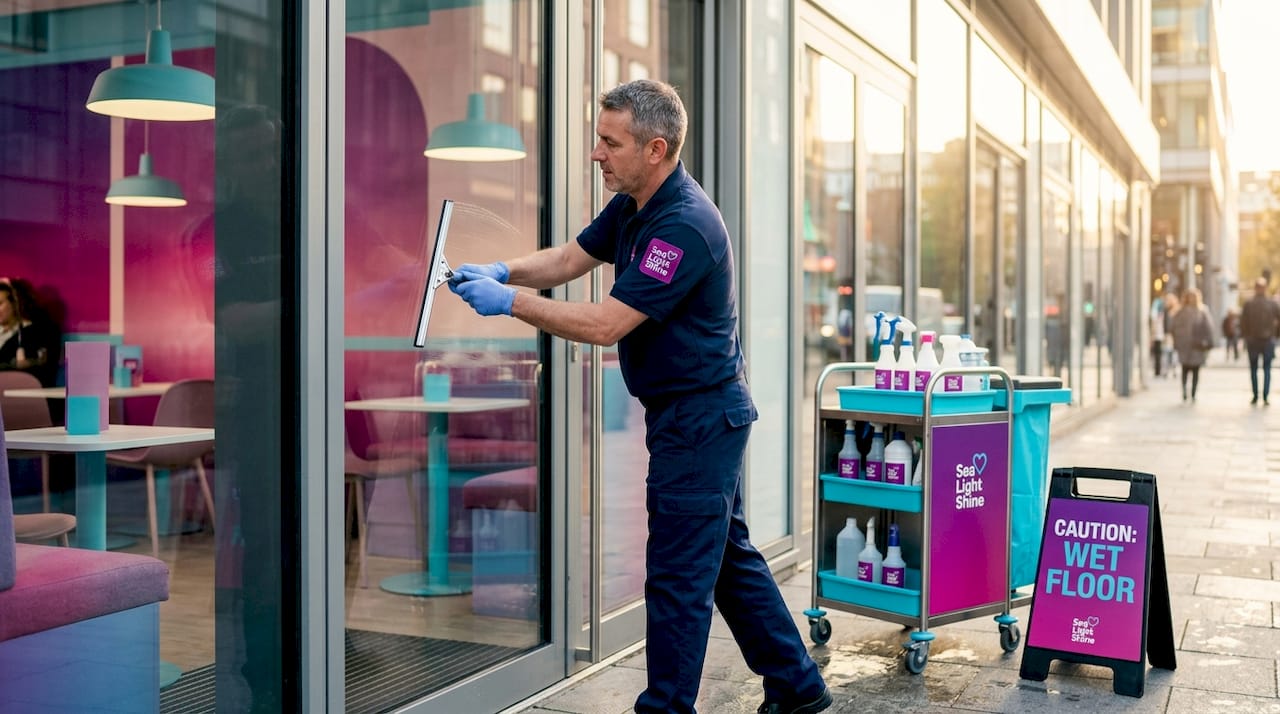
A commercial cleaning service is the professional, systematic maintenance and sanitation of non-residential buildings and shared-use facilities, following documented procedures and defined service scopes. According to ISSA, the global cleaning industry authority, commercial cleaning covers everything from routine janitorial tasks to specialised disinfection, depending on the environment. This guide explains the types of services available, how pricing works, what a commercial cleaning contract should contain, and how to choose the right contractor for your business.
What is a commercial cleaning service, exactly?
Commercial cleaning is the planned, repeatable cleaning of workplaces, institutions, and shared facilities. It differs from domestic cleaning in scale, complexity, and the regulatory standards it must meet. Where a residential cleaner might dust and hoover a family home, a commercial cleaner working in a hospital, school, or office block operates under documented protocols, uses industrial-grade equipment, and is accountable to health and safety legislation.
The industry body ISSA defines commercial cleaning as a discipline that underpins hygiene, safety, and operational standards rather than simply making a space look tidy. That distinction matters. A visually clean office can still harbour harmful bacteria if disinfection protocols are absent. For business owners and facilities managers, understanding this difference is the starting point for making informed decisions about their cleaning provision.
Commercial cleaning applies across a wide range of settings: corporate offices, retail units, GP surgeries, schools, gyms, warehouses, and Airbnb properties. Each environment carries its own hygiene requirements, footfall levels, and compliance obligations, which is why professional providers tailor their service scope accordingly. For a detailed breakdown of how commercial differs from domestic cleaning, Sealightshine has published a dedicated guide.
What types of commercial cleaning services are commonly offered?
Commercial cleaning is not a single service. It is a category that contains several distinct disciplines, each suited to different environments and business needs.
| Service type | Typical tasks |
|---|---|
| Routine janitorial | Dusting, vacuuming, restroom sanitation, waste removal |
| Floor care | Carpet cleaning, hard floor buffing, waxing, scrubbing |
| Window cleaning | Internal and external glass, frames, and sills |
| Post-construction cleaning | Debris removal, deep clean of newly built or renovated spaces |
| Infection control and disinfection | Electrostatic spraying, fogging, surface sanitisation in healthcare or high-traffic areas |
| Specialist cleaning | Gym equipment, communal areas, kitchen extraction systems |
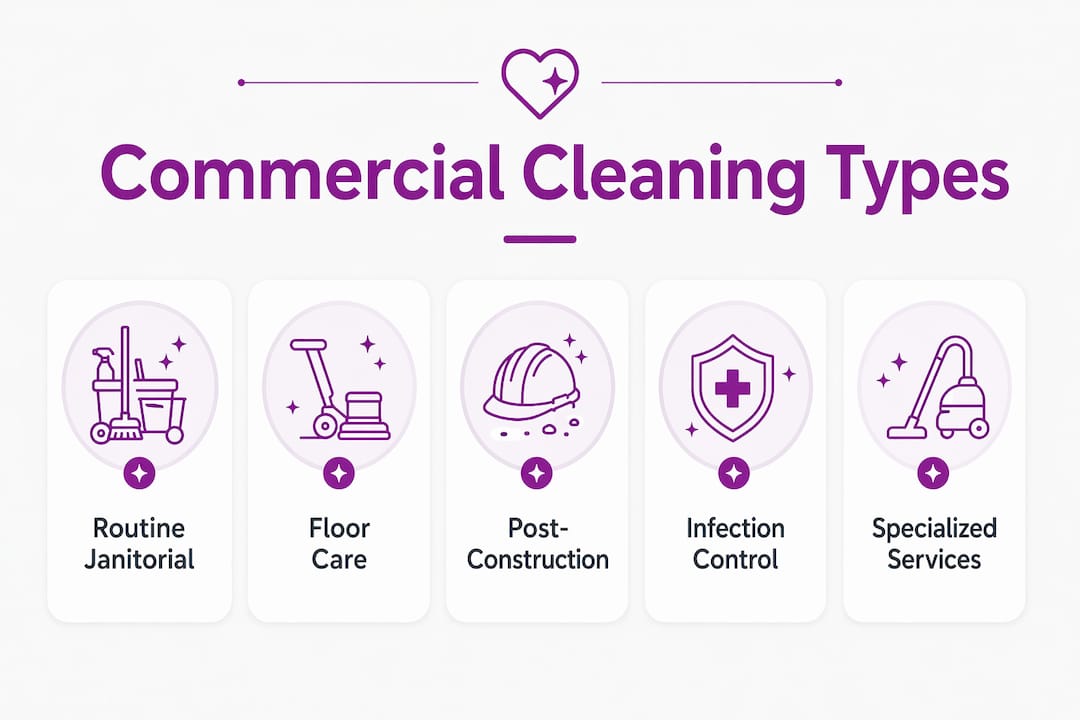
Routine janitorial work forms the backbone of most commercial contracts. It covers the daily or weekly tasks that keep a workplace functional: emptying bins, cleaning toilets, wiping surfaces, and vacuuming floors. These tasks are predictable, repeatable, and form the baseline of any service agreement.
Floor care is a separate discipline that requires specialist equipment. Carpet extraction machines, rotary scrubbers, and high-speed burnishers are standard tools for commercial floor technicians. Hard floors in retail or healthcare settings often need regular stripping and resealing to maintain both appearance and slip resistance.
Post-construction cleaning is a specialised service involving debris removal and deep cleaning tailored to newly built or renovated spaces. It requires distinct skill sets and equipment, and it is typically commissioned as a one-off project rather than an ongoing contract.
Infection control services have grown significantly in demand since 2020. Electrostatic disinfection, in particular, is now standard in healthcare settings, schools, and food production facilities. These services go well beyond surface wiping and require trained operatives using approved biocidal products.
Pro Tip: When reviewing a commercial cleaning proposal, ask the provider to list each service type separately with its own frequency and method. A single line reading “cleaning services” tells you nothing about what is actually being delivered.
How is commercial cleaning priced?
Commercial cleaning is most commonly priced using a square-footage model. The total monthly cost is calculated by multiplying the cleanable area by a rate per square foot, then adjusting for frequency, building type, and task complexity.
ISSA’s pricing data shows that general office cleaning rates typically fall between $0.09 and $0.17 per square foot per month. Medical and healthcare environments attract higher rates of $0.14 to $0.29 per square foot, reflecting the stricter protocols and compliance requirements involved. These figures are US benchmarks, but they illustrate the relative cost difference between standard and specialist environments, a pattern that holds true in the UK market as well.
| Service type | Approximate rate per sq ft |
|---|---|
| General office cleaning | $0.09–$0.17 |
| Medical and healthcare cleaning | $0.14–$0.29 |
| Carpet cleaning | $0.08–$0.30 |
| Electrostatic disinfection | $0.08–$0.30 |
Specialised tasks such as carpet cleaning and electrostatic disinfection are priced separately from routine cleaning, typically ranging from $0.08 to $0.30 per square foot. This separation is important because bundling specialist tasks into a flat rate often leads to either overpaying or receiving a lower standard of work.
Pricing also varies with building type, cleaning complexity, and required frequency. Base rates are starting points, not fixed prices. A 2,000 sq ft office cleaned three times per week will cost proportionally more than the same space cleaned once weekly, and the rate per visit may differ too.
Comparing bids accurately requires a consistent definition of cleanable square footage and equal task scopes across all proposals. Without this, you are not comparing like with like. One contractor may quote a lower headline figure by excluding restrooms or reception areas from their calculation.
Pro Tip: Before requesting quotes, produce a single scope document that lists every area to be cleaned, the floor type, the frequency required, and any specialist tasks. Send the same document to every contractor. This is the only way to compare bids fairly.
What is a commercial cleaning contract and why does it matter?
A commercial cleaning contract is a written service agreement that defines the scope of work, cleaning frequency, payment terms, cancellation conditions, and liability responsibilities between a client and a cleaning provider. Written contracts prevent misunderstandings that verbal arrangements cannot resolve, and they provide legal protection for both parties if a dispute arises.
The key elements a commercial cleaning contract should include are:
- Scope of work: every area to be cleaned, the tasks to be performed, and the products or methods to be used
- Frequency and schedule: how often each task is carried out and at what times
- Payment terms: the agreed rate, invoicing schedule, and consequences for late payment
- Cancellation and notice periods: how either party can end the agreement and with how much notice
- Liability and insurance: confirmation that the provider holds public liability insurance and the limits of their responsibility
- Compliance and security protocols: after-hours access, alarm handling, supply restocking, and building-specific requirements
Commercial contracts are more complex than residential agreements because they must address unique compliance and security concerns tied to business operations. A residential cleaning contract rarely needs to address alarm codes, COSHH data sheets, or NHS infection control standards. A commercial one often does.
For businesses setting up a new agreement, Sealightshine has published a contract checklist that covers the key elements to verify before signing. Understanding how cleaning contracts are structured also helps you negotiate better terms and avoid gaps in service coverage.
How to choose a commercial cleaning contractor
Choosing a commercial cleaning contractor on price alone is the most common mistake businesses make. The right provider is one whose processes, training, and compliance record match the demands of your specific environment.
- Define your requirements first. Write down every area to be cleaned, the frequency you need, and any specialist tasks before approaching any contractor. Vague briefs produce vague proposals.
- Check insurance and certifications. Any reputable commercial cleaning company holds public liability insurance of at least £1 million. Ask for the certificate, not just a verbal confirmation.
- Ask about training and supervision. Find out how operatives are trained, how their work is checked, and what happens when a regular cleaner is absent. Consistency depends on systems, not individuals.
- Request references from similar environments. A contractor experienced in retail is not automatically qualified for healthcare or food production. Ask for references from clients in your sector.
- Run a trial period. A short trial of four to eight weeks, with a clear review point, lets you assess quality before committing to a long-term contract.
- Evaluate the proposal on process, not just price. Providers should be assessed on process standards, training, and compliance rather than appearance or a low headline figure alone.
Pro Tip: Ask each contractor how they handle a complaint. A provider who describes a clear escalation process and a named contact is far more likely to resolve issues quickly than one who gives a vague answer. The response tells you more about their service culture than any brochure.
Key takeaways
Commercial cleaning is a professional discipline governed by documented procedures, formal contracts, and measurable standards, not simply a matter of keeping premises tidy.
| Point | Details |
|---|---|
| Definition of commercial cleaning | The systematic maintenance and sanitation of non-residential buildings, covering janitorial and specialist tasks. |
| Pricing model | Square-footage rates are the standard method; specialist tasks are priced separately and should be itemised. |
| Contract importance | Written agreements define scope, frequency, and liability, and provide legal protection for both parties. |
| Choosing a contractor | Evaluate on process standards, insurance, training, and sector experience, not price alone. |
| Scope clarity | Define cleanable area and task scope before requesting quotes to enable fair comparison of bids. |
Why I think most businesses underestimate what commercial cleaning actually involves
Most business owners I speak with think of commercial cleaning as a commodity. They assume any provider with a mop and a van will do, and they choose on price. That view costs them more in the long run than a well-structured contract ever would.
The businesses that get the most value from their cleaning provision are the ones that treat it as an operational function, not an afterthought. They define their scope clearly, they read their contracts before signing, and they review performance regularly rather than waiting for something to go wrong.
Pricing confusion is the most common source of frustration I see. A low quote that excludes specialist tasks, or one based on a different definition of cleanable area, will always look attractive until the invoice arrives. The fix is straightforward: use a consistent scope document and ask every contractor to price against the same brief.
The other thing worth saying plainly is that a clean workplace is not just about appearances. It affects employee wellbeing, client perception, and in regulated environments, legal compliance. Investing in a reliable, well-specified cleaning service is one of the most practical decisions a business can make.
— Kate
How Sealightshine supports businesses across East Anglia
Sealightshine was built specifically to address the problem of unreliable, inconsistent cleaning that too many businesses in East Anglia have experienced. Whether you manage an office, a retail unit, an Airbnb property, or a commercial facility, Sealightshine delivers tailored service agreements with clear scope, defined frequencies, and consistent quality.
From routine office cleaning to specialist deep cleaning and floor care services, every service is delivered by trained operatives who understand the difference between looking clean and being clean. If you are ready to work with a provider that prioritises punctuality and attention to detail, visit the Sealightshine commercial cleaning page to request a quote or discuss your requirements.
FAQ
What does a commercial cleaning service include?
A commercial cleaning service includes routine janitorial tasks such as vacuuming, restroom sanitation, and waste removal, as well as specialist services like floor care, window cleaning, and infection control. The exact scope is defined in a written service agreement between the client and the provider.
How is commercial cleaning different from residential cleaning?
Commercial cleaning operates at a larger scale, follows documented procedures, and must meet health and safety compliance standards that residential cleaning does not. It also involves formal contracts that address security access, liability, and building-specific protocols.
What should a commercial cleaning contract include?
A commercial cleaning contract should define the scope of work, cleaning frequency, payment terms, cancellation notice periods, and liability and insurance details. Written agreements provide legal protection and prevent disputes over what was or was not agreed.
How much does commercial cleaning cost per square foot?
General office cleaning typically costs between $0.09 and $0.17 per square foot per month, while medical environments attract rates of $0.14 to $0.29 per square foot. Specialist tasks such as carpet cleaning are priced separately and should be itemised in any proposal.
How do I choose a reliable commercial cleaning contractor?
Check that the contractor holds public liability insurance, ask for references from clients in your sector, and request a trial period before committing to a long-term contract. Assess proposals on process standards and training, not price alone.