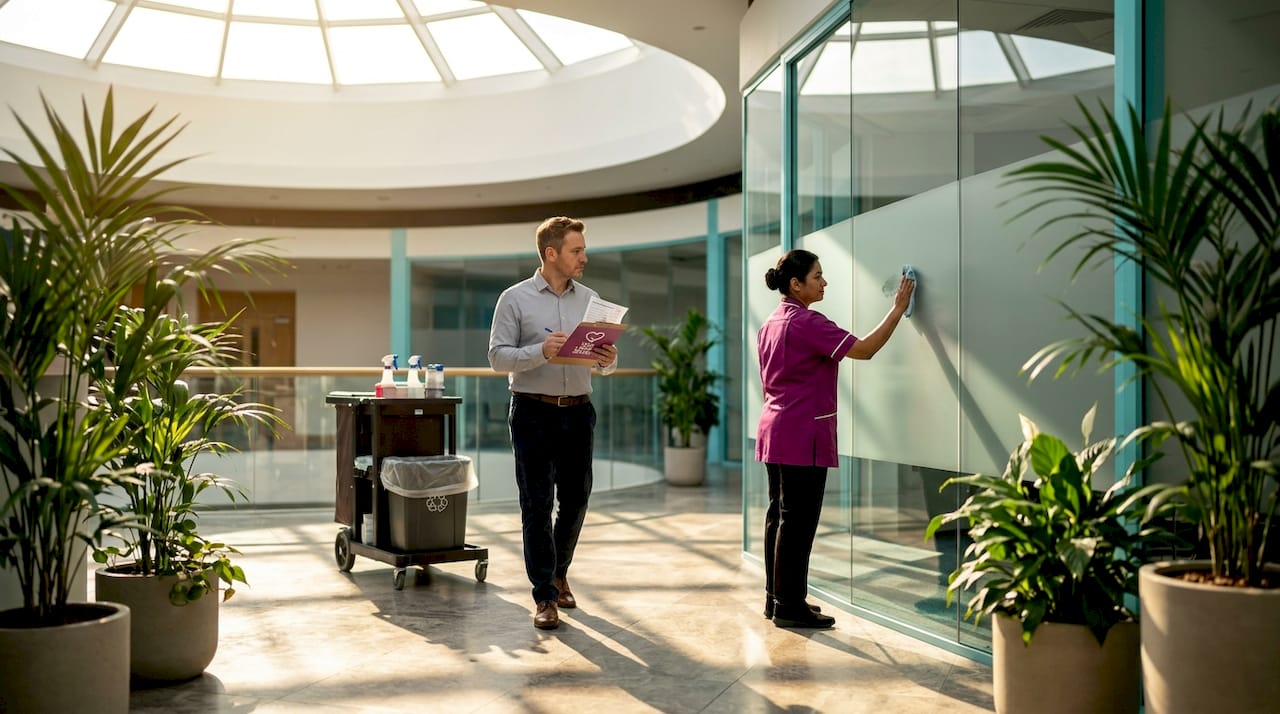
A cleaning schedule tells you when someone cleaned. A cleaning audit tells you how well they cleaned. Many property managers assume a ticked rota is proof of a hygienic facility, but that assumption leaves gaps that only a structured commercial cleaning inspection can reveal. Understanding what is a cleaning audit commercial in nature involves more than spotting a dirty floor. It means systematically assessing whether your cleaning provider is meeting agreed standards, satisfying health and safety requirements, and protecting your tenants, staff, and reputation. This article explains exactly what cleaning audits involve and how to make them work for your facility.
Table of Contents
- Key takeaways
- What a commercial cleaning audit actually is
- Why cleaning audits matter for your facility
- How to conduct a cleaning audit effectively
- Common challenges and how to overcome them
- Integrating audits with contracts and facility management
- My take on cleaning audits in commercial properties
- How Sealightshine supports audit-ready cleaning
- FAQ
Key takeaways
| Point | Details |
|---|---|
| Audits go beyond schedules | A cleaning audit measures quality outcomes, not just whether tasks were completed on time. |
| Structured checklists matter | Using scored checklists across all zones creates objective, repeatable quality assessments. |
| Restrooms need priority attention | Restrooms carry the highest complaint volume and require same-day corrective action on low scores. |
| Digital tools outperform paper | Digital inspection tools can improve cleanliness scores by up to 25% compared to paper-based methods. |
| Audits protect your contracts | Documented audit reports give you evidence to enforce contract terms and justify service decisions. |
What a commercial cleaning audit actually is
Most people use “cleaning audit” and “cleaning schedule” interchangeably. They are not the same thing. A cleaning schedule describes tasks and their frequency. A commercial cleaning audit is a structured, documented inspection that measures whether those tasks have been carried out to an agreed standard. The distinction matters enormously if you manage a commercial facility where hygiene, compliance, and tenant satisfaction are all at stake.
A typical commercial cleaning inspection covers several core components:
- A scored checklist covering every zone in the facility, from restrooms and kitchens to office areas and communal corridors
- A rating system that assigns numerical scores to each area, allowing you to track performance over time rather than relying on impressions
- Photographic evidence capturing both passed and failed standards at the time of inspection
- A written report summarising findings, scores, and any required corrective actions
- Operational inputs such as dilution ratios for cleaning chemicals, dwell times, and equipment condition, because cleaning quality depends on more than what is visible to the naked eye
Standards referenced in commercial audits often include APPA (Association of Physical Plant Administrators) cleanliness scoring, which rates areas on a one-to-four scale. OSHA hygiene regulations for workplaces also inform what constitutes an acceptable standard in areas like restrooms and food preparation zones. Knowing which standard your audit references gives you a defensible benchmark rather than a vague sense that something looks “clean enough.”
Inspection checklists promote consistency across all assessed areas, making it far easier to compare performance week on week and identify whether scores are improving or slipping.
Why cleaning audits matter for your facility
Running a commercial property without regular audits is like managing a budget without looking at the numbers. You might have a general sense of how things are going, but you will not catch problems until they become expensive or embarrassing.
The importance of cleaning audits comes down to five practical benefits:
- Regulatory compliance. Workplaces have legal obligations under health and safety legislation. An audit creates a documented trail showing that hygiene standards are actively monitored, not just assumed.
- Early problem detection. Audits catch issues before tenants complain or before a health inspector finds them. A single failed restroom inspection is far less costly than a health citation or a lost tenant.
- Objective performance tracking. Anecdotal feedback (“the office always smells fine”) is unreliable. Scored audits give you data that is consistent, comparable, and credible.
- Smarter budgeting. Well-run audits help you justify cleaning budgets, allocate resources to the highest-need areas, and avoid overpaying for services that are underdelivering.
- Transparency with clients and tenants. Sharing audit results builds genuine trust. It demonstrates that cleanliness in your facility is actively managed, not left to chance.
“Cleaning audits shift facility management from subjective opinions to data-driven decisions, enabling accurate budgeting and resource allocation based on historical trends.”
This shift from gut feeling to documented evidence is what separates reactive facility management from proactive operations. If your current cleaning arrangement relies entirely on trust, you are managing a risk, not a standard.
How to conduct a cleaning audit effectively
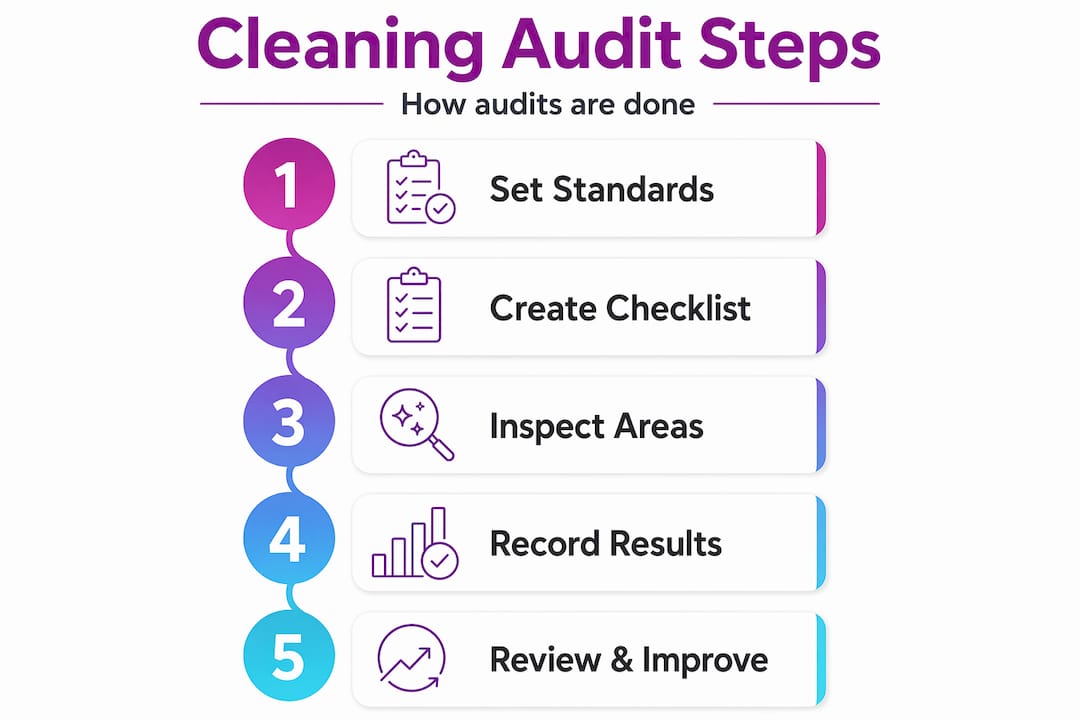
Good cleaning audit procedures do not require expensive consultants. What they do require is structure, consistency, and the right tools. Here is a practical sequence for property managers and business owners setting up or improving their audit process.
-
Define your zones and scoring criteria. Map every area of your facility and assign specific standards to each. Restrooms, kitchens, reception areas, corridors, and office spaces each need their own set of criteria because they carry different hygiene risks.
-
Set your inspection frequency. Not all zones need auditing at the same rate. Restrooms have the highest complaint density of any area in a commercial building, so they should be inspected far more frequently than, say, a storage room. As a baseline, high-traffic areas warrant daily checks.
-
Time your inspections correctly. Always conduct the audit after cleaning has been completed but before the area is occupied again. This gives you an accurate picture of what the cleaning provider actually delivered, not what happened after staff or tenants have used the space.
-
Train your auditors. An audit is only as reliable as the person conducting it. Anyone carrying out a cleaning quality assessment should be briefed on the scoring criteria, shown examples of passing and failing standards, and given consistent guidance on photographing evidence.
-
Use digital tools. Digital inspection tools improve APPA cleanliness scores by up to 25% compared to paper-based verification methods. Apps that capture photos, log GPS locations, and timestamp entries remove ambiguity and create an audit trail that holds up to scrutiny.
-
Establish corrective action protocols. A cleaning audit is only useful if low scores trigger a response. Define your thresholds in advance. For example, any area scoring below 2.5 on a four-point scale should prompt same-day contractor notification and a re-inspection within 24 hours.
Pro Tip: Schedule at least one unannounced audit per month. Announced inspections tell you what your cleaner can do when they know you are watching. Unannounced ones tell you what they actually do.
Common challenges and how to overcome them

Even property managers who understand the value of audits run into practical obstacles. Knowing what these obstacles look like means you can address them before they undermine your entire cleaning quality assessment process.
The table below outlines the most common issues and practical solutions:
| Challenge | Why it happens | How to address it |
|---|---|---|
| Incomplete or inconsistent records | Paper-based systems are easy to skip or lose | Switch to a digital inspection app with mandatory fields |
| Contracts without inspection clauses | Cleaning agreements drafted without accountability terms | Use a cleaning contract checklist that includes reporting requirements |
| Contractor resistance to audits | No accountability built into the service agreement | Include audit compliance as a contractual obligation from day one |
| Overlooked zones | Auditors focus on visible areas and skip back-of-house spaces | Use a fixed checklist that covers every defined zone, no exceptions |
| Scoring inconsistency between auditors | Different people interpret the same standard differently | Create a reference guide with photographic examples of each score level |
Contracts lacking named supervisors or inspection reporting fall below professional standards, and this is where many facility managers discover their vulnerability only after a problem occurs. Building the audit requirement into the contract from the outset is the only reliable safeguard.
Pro Tip: If a contractor refuses to participate in a structured audit process, treat that refusal as a red flag about the quality of service they are confident delivering.
Frequency gaps are another overlooked issue. Audits provide proof of performed work and allow recurring problem areas to be tracked over time. If your records show that a particular restroom scores poorly every Monday morning, you have the data to act. Without those records, you are guessing.
Integrating audits with contracts and facility management
A cleaning audit does not exist in isolation. Its real power comes from being embedded into your contract structure and your broader facility management programme. Without this integration, audit findings sit in a folder and nothing changes.
Here is how the connection should work in practice:
- Audit reports as contract evidence. Your signed cleaning contract should state the expected cleanliness standard. Your audit reports then document whether that standard is being met. If it is not, you have written evidence to support remediation, penalty clauses, or contract termination.
- Building-specific scopes of work. Generic contracts invite generic cleaning. A building-specific scope of work names every area, every task, and every frequency, giving your audit checklist something concrete to measure against.
- Contract renewals informed by data. When a cleaning contract comes up for renewal, audit scores give you an objective basis for your decision. You are not relying on whether the cleaner “seems fine.” You have months of performance data.
- Alignment with health and safety policy. Your organisation’s health and safety obligations extend to hygiene. Embedding audit results into your H&S reporting demonstrates active compliance management rather than passive assumption.
- Continuous improvement through feedback. Regular audit results, shared constructively with your cleaning provider, create a feedback loop. Good providers will use the data to improve their performance. Poor providers will reveal themselves quickly.
The key principle is that auditing should not feel adversarial. When the process is transparent and the standards are agreed upfront, cleaning providers generally welcome the clarity.
My take on cleaning audits in commercial properties
I have reviewed enough cleaning arrangements for commercial properties to know that the gap between what managers assume is happening and what is actually happening can be significant. Regular cleaning schedules alone are not enough. A rota tells you someone showed up. It says nothing about whether they cleaned behind the toilet, changed the mop head, or used the correct dilution ratio.
What I have found is that the properties with the fewest complaints and the best tenant retention are almost always the ones running structured audits. Not because they hired better cleaners. Because they created a system that made quality visible and measurable.
The biggest misconception I encounter is that audits are punitive, that they exist to catch people out. In reality, the best audit processes I have seen are collaborative. The cleaning provider gets clear feedback. The facility manager gets documented assurance. Everyone knows what good looks like.
Restrooms deserve particular attention. Every time I see a commercial property with persistent tenant complaints, restrooms are almost always the source. The highest complaint density sits in these spaces, and yet they are often the zones audited least rigorously. If you audit nothing else, audit your restrooms thoroughly and often.
Technology has genuinely shifted what is possible here. Digital tools that capture timestamps, photos, and scores in real time have transformed audit credibility. A paper checklist signed by the same person doing the cleaning is not an audit. It is a paper exercise.
— Kate
How Sealightshine supports audit-ready cleaning
At Sealightshine, we built our commercial cleaning services around exactly the kind of accountability that audits demand. We understand that property managers and business owners in East Anglia need more than a cleaner who shows up. They need a provider whose work can withstand scrutiny.
Our commercial cleaning services are structured to support your inspection and reporting requirements from day one. Whether you need thorough deep cleaning services to bring a facility up to audit standard, specialist floor and communal area cleaning, or a consistent office cleaning programme with documented quality control, we work to the standards your audits require. We are punctual, professional, and transparent. If you want a cleaning partner whose performance you can measure, not just trust, get in touch with Sealightshine today to discuss a tailored solution for your facility.
FAQ
What is a commercial cleaning audit?
A commercial cleaning audit is a structured inspection that assesses whether cleaning tasks have been carried out to an agreed quality standard. It uses a scored checklist, photographic evidence, and a written report to provide objective, documented proof of service quality.
How often should a commercial cleaning audit be carried out?
High-traffic zones such as restrooms should be audited daily or after every clean, while lower-risk areas may be inspected weekly or monthly. The key is to align audit frequency with the complaint and hygiene risk level of each zone.
What should a cleaning audit checklist include?
A cleaning audit checklist should cover all facility zones, including restrooms, kitchens, offices, and communal areas. Each zone should have scored criteria, space for photographic evidence, and a corrective action section for any failures recorded during the inspection.
Can a cleaning audit help enforce a cleaning contract?
Yes. Audit reports create a documented record of whether your cleaning provider is meeting the standards set out in the contract. If scores consistently fall below agreed thresholds, you have written evidence to support remedial action, financial penalties, or contract termination.
What score triggers corrective action in a cleaning audit?
Under the APPA scoring system, any area scoring below 2.5 on a four-point scale should trigger same-day contractor notification. Restrooms in particular require immediate corrective action due to their high complaint volume and health and safety implications.