Professional cleaning is a structured service built on repeatable workflows, trained staff, and quality controls that deliver consistent results across homes, offices, and managed properties. Unlike a quick tidy-up, the professional cleaning process follows a defined sequence from initial assessment through to final inspection, using commercial-grade equipment and tested methods. Landlords, property managers, and Airbnb hosts in particular benefit from understanding how cleaning services operate, because it helps them set realistic expectations, brief cleaners accurately, and get measurably better outcomes from every visit.
What are the main steps in the professional cleaning process?
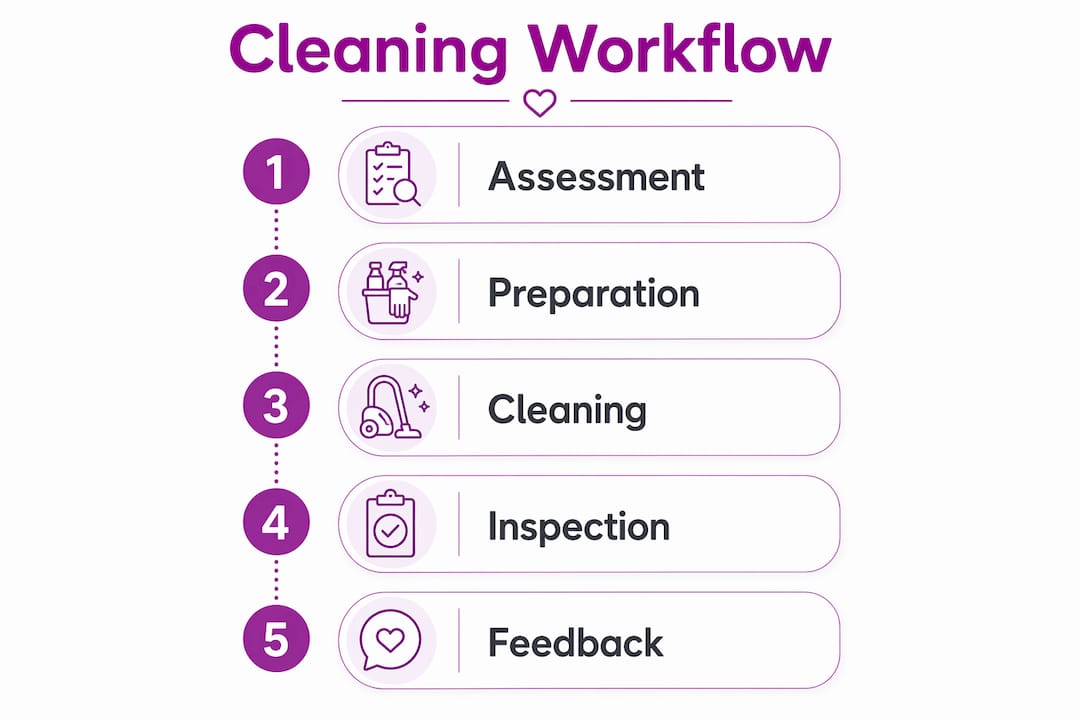
The professional cleaning workflow begins before a single cloth is picked up. A reputable provider starts with an initial assessment, either a physical walkthrough of the property or a virtual consultation, to understand the scope of work. This stage determines which areas need attention, what surfaces are present, and whether any specialist treatments are required.
From that assessment, the provider produces a written scope of work. This document lists every area to be cleaned, the tasks included, the frequency, and any exclusions. It protects both parties and removes ambiguity about what “clean” actually means in practice.
The typical sequence from first contact to completed clean runs as follows:
- Initial enquiry and site assessment — the client describes the property and requirements; the cleaner visits or conducts a virtual walkthrough.
- Written scope of work — a detailed document confirming areas, tasks, and any special instructions.
- Pricing proposal and agreement — costs are confirmed based on the scope, frequency, and property type.
- Scheduling — a recurring or one-off appointment is booked, with access arrangements confirmed.
- On-site execution — trained staff work through the property using checklists, following a room-by-room sequence.
- Final inspection — a supervisor or lead cleaner reviews the work against the checklist before sign-off.
Pro Tip: Ask your cleaning provider to share the written scope of work before the first visit. Reviewing it together takes ten minutes and prevents weeks of misunderstanding about what is and is not included.
The final inspection step is one that many clients overlook when comparing providers. A company that skips supervisor review is relying entirely on individual cleaner judgement, which introduces inconsistency. The supervisor inspection is what separates a professional operation from a casual arrangement.
What equipment and cleaning agents do professionals use?
Professional cleaners use commercial-grade tools that are simply not available in most supermarkets. HEPA-filter vacuums, microfibre cloths, and auto scrubbers are standard in reputable operations. HEPA filters capture particles as small as 0.3 microns, making them far more effective than domestic models at removing allergens and fine dust from carpets and upholstery.
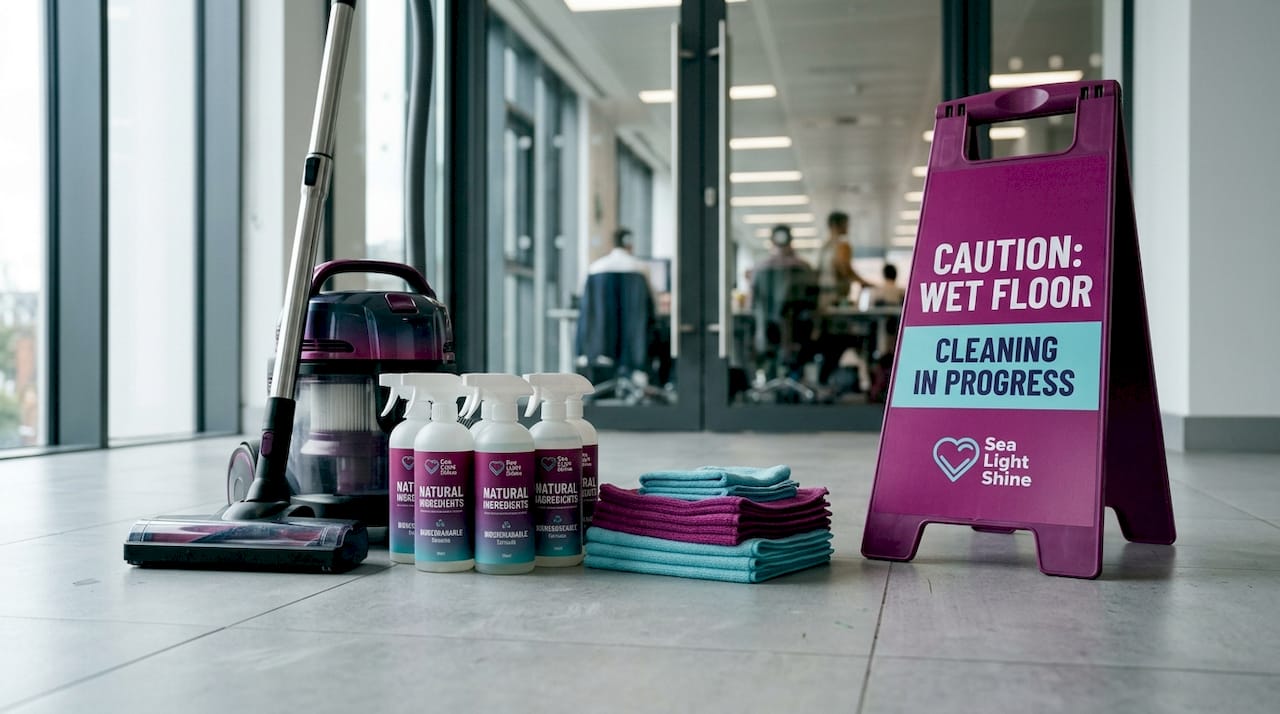
Colour-coded cloths are a practice that surprises many clients. Each colour is assigned to a specific area of the property: typically red for toilets, yellow for other bathroom surfaces, blue for general areas, and green for kitchens. This system prevents bacteria from a toilet being transferred to a kitchen worktop, which is a genuine cross-contamination risk in any property.
Key equipment and agents used in professional cleaning:
- HEPA-filter vacuum cleaners for deep extraction from carpets and soft furnishings
- Microfibre cloths (colour-coded) to prevent cross-contamination between zones
- Auto scrubbers and rotary floor machines for hard flooring in commercial or large residential spaces
- Commercial disinfectants with verified kill rates for bacteria and viruses
- Eco-friendly alternatives such as plant-based degreasers and low-VOC products for sensitive environments
One detail that is frequently misunderstood is disinfectant contact time. For a disinfectant to kill pathogens effectively, the surface must remain visibly wet for three to ten minutes depending on the product. If the surface dries before that time has elapsed, the disinfectant must be reapplied. This is why professional cleaners apply disinfectant to one area, move to another task, and return to wipe down. It is not inefficiency. It is correct technique.
| Surface type | Recommended approach | Contact time |
|---|---|---|
| High-touch points (door handles, switches) | Commercial disinfectant spray | 3 to 10 minutes |
| Kitchen worktops | Food-safe disinfectant, then rinse | 5 minutes minimum |
| Bathroom basins and taps | Colour-coded cloth, disinfectant | 3 to 5 minutes |
| Hard flooring | Auto scrubber or mop with diluted solution | Per product label |
| Carpets and soft furnishings | HEPA vacuum, spot treatment | N/A |
Pro Tip: If you manage a property where guests or tenants rotate frequently, ask your cleaning provider to confirm the disinfectant contact times they use for bathrooms and kitchens. It is a quick way to assess whether their protocols are genuinely effective.
It is also worth noting that routine disinfection of all surfaces when no illness is present adds limited health benefit and increases chemical exposure unnecessarily. Professional providers reserve full disinfection protocols for bathrooms, food preparation areas, and periods following illness, which is the correct, evidence-based approach.
How do professional cleaners maintain consistency and quality?
Consistency is the defining characteristic that separates a professional cleaning service from an informal arrangement. The mechanism behind it is standardisation. SOPs, written checklists, and sequencing rules mean that a property is cleaned to the same standard whether it is the same cleaner’s tenth visit or a new team member’s first.
The sequencing rule most widely used is top-to-bottom, back-to-front cleaning. Cleaners begin at ceiling level (light fittings, shelves, tops of cupboards) and work downward so that any dislodged dust falls onto surfaces not yet cleaned. They then work from the far end of a room toward the exit to avoid walking over cleaned floors. These rules are not optional preferences. They are written into the SOP and checked during inspection.
Key quality controls used by professional cleaning companies:
- Written cleaning checklists specific to each property or property type
- Supervisor spot checks during and after each clean
- Photographic records of completed work in some commercial contracts
- Client feedback forms or digital review requests after each visit
- Regular staff training refreshers on technique and product use
“Standardisation is the major driver ensuring professional cleaning consistency, allowing clients to receive predictable quality regardless of staff changes.” — How cleaning companies work behind the scenes
For property managers overseeing multiple units, this matters enormously. A commercial cleaning contract checklist gives you a documented reference point for every visit, which makes it straightforward to raise concerns and hold providers accountable without relying on memory or subjective impressions.
How does pricing, scheduling, and communication work?
Cleaning pricing follows three main models: flat rate per visit, hourly rate, or a rate calculated per square metre. Each model suits different situations.
| Pricing model | Best suited to | Typical consideration |
|---|---|---|
| Flat rate per visit | Residential properties with consistent scope | Predictable costs; scope must be clearly defined |
| Hourly rate | Variable or ad hoc cleans | Flexible but harder to budget for |
| Per square metre | Large commercial or industrial spaces | Accurate for big footprints; requires measurement |
Frequency affects cost in a way that surprises many new clients. More frequent cleaning visits tend to cost less per visit because the property does not accumulate as much soil between sessions, meaning each clean takes less time. A weekly clean is almost always cheaper per visit than a monthly deep clean of the same property. Planning your cleaning schedule with frequency in mind is one of the most practical ways to manage costs without reducing standards.
Communication before and between visits is equally important. Clients who provide written instructions, note any areas of concern, and flag changes to the property (new furniture, a recent spill, a pet that has been unwell) get consistently better results. Cleaning services are not mind-reading operations. The more specific your briefing, the more targeted the clean.
Clarifying scope before the first visit also prevents disputes about what is included. Some tasks, such as washing dishes or doing laundry, may fall outside a standard clean and attract additional charges. Confirming this in writing at the outset removes any ambiguity.
What should you expect from a professional cleaning service?
A professional cleaning visit covers a defined set of tasks, and understanding those boundaries helps you prepare properly. Most residential and commercial cleans include dusting surfaces, vacuuming and mopping floors, cleaning bathrooms and kitchens, emptying bins, and wiping down high-touch points. Specialist tasks such as oven cleaning, window cleaning, or carpet extraction are usually priced separately.
Decluttering before a cleaner arrives is one of the most effective things you can do to improve outcomes. When surfaces are clear of toys, paperwork, or clothing, cleaners can focus on sanitising rather than organising. Vacuuming performance in particular improves significantly when floor space is unobstructed.
What to prepare before a professional cleaning visit:
- Clear surfaces of clutter so cleaners can access them directly
- Secure or remove valuables and fragile items
- Inform the provider about pets, especially those that may be anxious or in the way
- Leave written notes about any priority areas or recent issues
- Confirm access arrangements, including key codes or key handover
There is a meaningful difference between a general clean, a deep clean, and a specialised clean. A general clean maintains a property that is already in reasonable condition. A deep clean addresses built-up grime, neglected areas, and surfaces that have not been treated in some time. Specialised cleans, such as end-of-tenancy or post-construction cleaning, follow specific protocols suited to those contexts. If you manage a holiday let, for example, the cleaning frequency and method between guest stays differs significantly from a standard domestic routine.
Professional cleaners do not handle biohazardous materials, pest infestations, or structural repairs. These fall outside the scope of cleaning services and require specialist contractors.
Key takeaways
Professional cleaning works because it combines standardised procedures, commercial-grade equipment, and structured quality controls to deliver consistent, verifiable results across any property type.
| Point | Details |
|---|---|
| Structured workflow | Every professional clean follows a defined sequence from assessment to final inspection. |
| Equipment matters | HEPA vacuums, colour-coded cloths, and auto scrubbers prevent cross-contamination and improve results. |
| Disinfectant contact time | Surfaces must stay visibly wet for three to ten minutes for disinfectants to work effectively. |
| Standardisation drives consistency | SOPs and checklists ensure the same quality regardless of which staff member attends. |
| Preparation improves outcomes | Decluttering before a visit and providing written instructions directly improves cleaning quality. |
Why I think most people underestimate what good cleaning actually involves
Most clients I speak with assume that professional cleaning is simply domestic cleaning done faster. It is not. The difference lies in the systems behind the service, not the speed of the person holding the cloth.
What I have seen repeatedly is that properties managed without a written scope of work end up in disputes. The client expected one thing; the cleaner delivered another. Neither party was dishonest. The problem was the absence of a documented agreement. A written scope of work is not bureaucracy. It is the foundation of a functional working relationship.
The other misconception I encounter often is that a higher hourly rate automatically means a better clean. It does not. A cleaner working without a checklist and without supervisor oversight can charge a premium rate and still miss the same corners every visit. The quality controls behind the service matter more than the headline price.
For property managers in particular, the real value of professional cleaning is not just cleanliness. It is the documentation, the reliability, and the accountability that comes with a properly run operation. That is what protects your property, your tenants, and your reputation.
— Kate
How Sealightshine delivers on these standards
Sealightshine was built specifically to address the inconsistency that landlords, business owners, and Airbnb hosts across East Anglia encounter with cleaning providers. Every clean follows a written scope of work, a property-specific checklist, and a final review before the team leaves. Whether you need a thorough deep cleaning service for a property refresh or a scheduled commercial cleaning programme for your business premises, Sealightshine brings trained staff, professional equipment, and documented quality controls to every visit. Contact the team to discuss a tailored plan for your property.
FAQ
What does a professional cleaning service include?
A standard professional clean covers dusting, vacuuming, mopping, bathroom and kitchen cleaning, bin emptying, and wiping high-touch surfaces. Specialist tasks such as oven or carpet cleaning are usually quoted separately.
How often should a property be professionally cleaned?
Frequency depends on occupancy and use. Residential properties typically benefit from weekly or fortnightly visits, while commercial premises often require daily or several-times-weekly cleaning. More frequent visits cost less per session because less soil accumulates between cleans.
Do professional cleaners bring their own supplies?
Most professional cleaning companies bring their own equipment and products, but confirming this with your provider before the first visit is advisable. Some services allow clients to specify preferred products, particularly for eco-friendly or allergy-sensitive environments.
What is the difference between a general clean and a deep clean?
A general clean maintains a property already in reasonable condition, covering routine tasks on each visit. A deep clean addresses built-up grime, neglected areas, and surfaces not treated during routine visits, and typically takes significantly longer.
How do cleaning companies maintain quality across different staff?
Standardised checklists and SOPs ensure that every cleaner follows the same sequence and covers the same areas, regardless of experience level. Supervisor inspections after each clean provide an additional layer of accountability.