
Properties that rely on ad hoc cleaning arrangements face up to three times more tenant complaints about hygiene and maintenance than those with structured janitorial programmes in place. If you manage residential lets, commercial offices, or short-term rental properties in East Anglia, that statistic should make you pause. Many property owners treat cleaning as an afterthought, booking a cleaner when something goes wrong rather than preventing problems from building up. This guide will define janitorial service properly, explain the standards that separate professional programmes from inconsistent one-off visits, and show you exactly what to expect when you invest in reliable, scheduled cleaning.
Table of Contents
- What is janitorial service?
- Core tasks and standards in janitorial programmes
- How is janitorial service scheduled and managed?
- Janitorial service vs deep and commercial cleaning
- What property managers gain from scheduled janitorial services
- Why structured janitorial contracts are a game changer
- Connect with reliable janitorial expertise in East Anglia
- Frequently asked questions
Key Takeaways
| Point | Details |
|---|---|
| Janitorial service defined | Janitorial service means scheduled, contract-based day-to-day cleaning for all types of properties. |
| Core tasks and standards | Professional programmes follow specific routines, standards, and quality controls to ensure reliable results. |
| Scheduling and management | Routine cleaning is planned and staffed using industry benchmarks for efficiency and consistency. |
| Benefits for managers | Consistent janitorial care simplifies property management and improves satisfaction for tenants and staff. |
What is janitorial service?
Janitorial service is not simply “getting someone in to clean.” It is a structured, contract-based arrangement for recurring day-to-day cleaning and upkeep, applied to both commercial premises and residential properties on a scheduled basis. As defined by industry sources, janitorial service is recurring, contract-based cleaning performed on a predictable schedule, typically daily or several times per week, rather than as a one-off response to visible dirt.
This distinction matters enormously. A one-off clean addresses what is already visible. A janitorial programme prevents dirt, bacteria, and disorder from accumulating in the first place. It is the difference between reactive and proactive property management.
“Janitorial service is best understood as the backbone of a property’s hygiene strategy. Without it, even well-maintained buildings begin to degrade in ways that are costly and difficult to reverse.”
Janitorial programmes typically serve:
- Office buildings and workspaces requiring daily turnaround
- Residential letting properties with high tenant turnover
- Retail and hospitality premises where public footfall demands consistent standards
- Airbnb and short-term rental properties needing reliable between-guest cleaning
- Estate agency managed properties where presentation directly affects lettability
Standard tasks within a janitorial service programme include rubbish removal, restroom cleaning and sanitation, floor care (vacuuming and mopping), dusting surfaces, restocking consumables such as hand soap and paper products, and disinfecting high-touch areas like door handles and light switches. If you are exploring your options, our commercial cleaning services and domestic cleaning options cover the full spectrum of what a structured programme can deliver.
Core tasks and standards in janitorial programmes
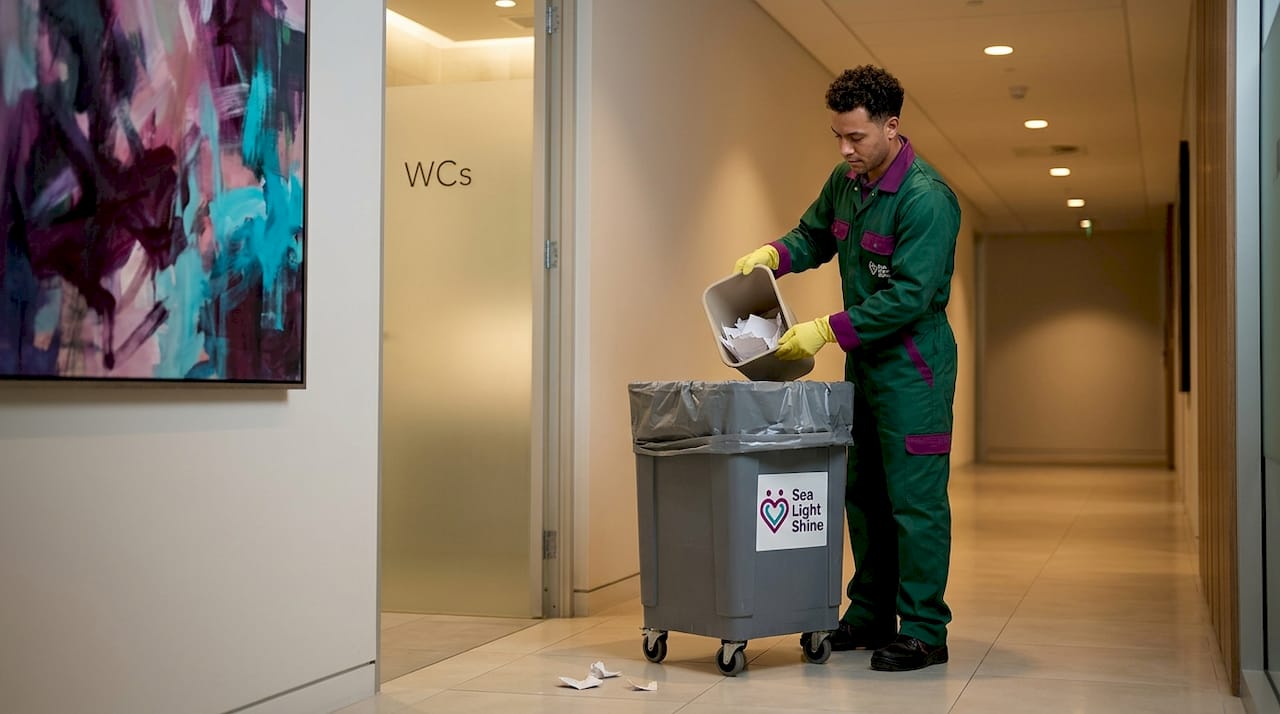
Having defined janitorial service, let’s examine the specific tasks and professional standards that underpin effective programmes. Not all cleaning is equal. What separates a professional janitorial programme from an unreliable arrangement is the use of standardised procedures, defined sequences, and measurable quality benchmarks.
Common baseline tasks in any credible programme include the following:
- Rubbish removal from all rooms, waste stations, and communal areas
- Restroom sanitation including toilet, basin, and fixture disinfection
- Supply restocking of soap, paper towels, and bin liners
- Floor vacuuming and mopping across all hard and carpeted surfaces
- Breakroom and kitchen cleaning, including appliance wipe-downs and sink sanitation
- Dusting of accessible surfaces, shelves, and fixtures
- Disinfection of high-touch points such as handles, switches, and shared equipment
These tasks form the foundation, but the quality of delivery depends entirely on how they are performed. This is where industry standards come in.
Many structured cleaning programmes rely on SOP-style (standard operating procedure) frameworks that specify how each task must be performed, which tools and chemicals are approved, the correct sequence of operations, and how quality control is maintained. One widely referenced framework is the ISSA’s Power Clean standard, which sets out detailed criteria to ensure cleaning is done safely, efficiently, and consistently across different facility types.
Pro Tip: When vetting a janitorial provider, ask whether they follow documented SOPs. A provider who cannot produce written procedures is likely delivering inconsistent results, regardless of how polished their sales pitch sounds.
| Task | Frequency | Standard benchmark |
|---|---|---|
| Rubbish removal | Daily | All bins emptied and relined |
| Restroom sanitation | Daily or twice daily | Full disinfection of fixtures |
| Floor vacuuming | Daily | All carpeted areas covered |
| Hard floor mopping | Daily or every other day | No streaks or standing water |
| Surface dusting | Daily or weekly | All accessible surfaces covered |
| High-touch disinfection | Daily | All handles, switches, keypads |
| Breakroom cleaning | Daily | Appliances, sink, and surfaces |
For properties that have recently undergone renovation or construction, the scope of typical janitorial tasks can expand significantly to address post-build debris and dust before a routine programme begins.
How is janitorial service scheduled and managed?
With the tasks and standards in mind, it’s crucial to understand how scheduling and management ensure the reliability of janitorial services. This is where many ad hoc arrangements fall apart. Without proper scheduling, even well-intentioned cleaning becomes patchy and unpredictable.
Effective janitorial scheduling depends on three core factors:
- Building type and use. A busy retail unit with hundreds of daily visitors needs a fundamentally different schedule from a small letting property with one tenancy per month.
- Building size and layout. Square footage, number of floors, restroom count, and communal spaces all affect how much time each visit requires.
- Soil levels and risk areas. High-traffic corridors, shared kitchens, and restrooms accumulate grime faster than private offices or storage rooms and must be visited more frequently.
A practical benchmark for getting this right comes from ISSA Cleaning Times, an industry-standard resource that links specific tasks to time estimates, helping property managers and cleaning providers calculate accurate staffing requirements and visit frequencies for different facility types.
Statistic to note: Properties that use workloading tools such as ISSA Cleaning Times to plan their cleaning rotas report significantly fewer instances of missed tasks and staffing shortfalls compared to those relying on informal estimates.
Ongoing management is equally important. A well-run janitorial programme includes:
- Regular quality inspections carried out by a supervisor or account manager
- Client feedback loops that allow property managers to flag concerns promptly
- Written records of completed visits and tasks for accountability
- Scheduled reviews to adjust frequency or scope as the property’s needs change
If you want to understand how professional providers approach this level of professional cleaning management, structured oversight is what separates a reliable contract from a frustrating one.
Janitorial service vs deep and commercial cleaning
Once you know how janitorial programmes operate, a common question is how they differ from one-off deep or commercial cleans. This confusion is understandable, because both involve professional cleaners and professional equipment. But the purpose, scope, and timing are quite different.
Janitorial service is preventative and continuous. It maintains an acceptable baseline of cleanliness day to day, stopping problems from building up. Deep cleaning is restorative and periodic. It addresses grime, buildup, and contamination that routine cleaning cannot reach, such as grout, behind appliances, inside ventilation, or heavily soiled carpets.
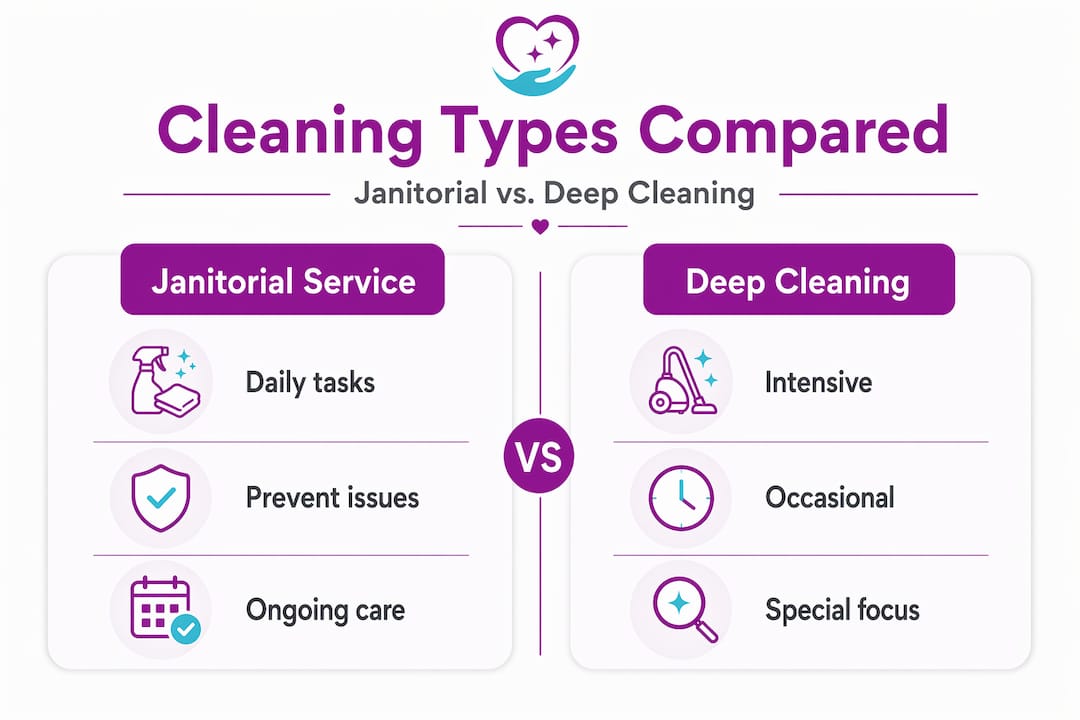
| Cleaning type | Purpose | Frequency | Example |
|---|---|---|---|
| Janitorial service | Maintain daily standards | Daily or several times weekly | Office cleaning after hours |
| Deep cleaning | Restore and remediate | Quarterly or after an event | End-of-tenancy clean |
| Commercial project clean | Specialist one-off work | As required | Post-construction cleanup |
Property managers benefit most from a hybrid approach: consistent janitorial care for daily upkeep, combined with periodic deep or project cleans for restoration. This hybrid model controls costs while ensuring that neither routine maintenance nor deeper remediation is neglected.
Pro Tip: Schedule a deep clean at least once per quarter for high-traffic commercial properties, and after every tenancy change for residential lets. This prevents issues that daily janitorial routines simply cannot address, such as limescale accumulation, grout discolouration, and odour buildup in soft furnishings.
When to choose each option:
- Daily janitorial service for ongoing operational hygiene in offices, retail units, and managed residential properties
- Deep vs regular cleaning assessment when you are unsure whether a property needs restoration or maintenance
- Periodic deep cleaning via a deep house cleaning guide for residential landlords preparing properties between tenancies
- Specialist project cleaning via professional deep cleaning for post-event, post-construction, or remediation scenarios
Understanding this distinction saves property managers both money and frustration. Booking a deep clean when you need daily maintenance, or relying on routine cleaning when restoration is required, both lead to the same outcome: a property that never quite reaches the standard you need.
What property managers gain from scheduled janitorial services
Understanding the distinctions, let’s review what property managers and owners actually stand to gain from a well-managed janitorial agreement. The benefits go well beyond a tidy appearance.
Fewer complaints, higher satisfaction. Consistent cleanliness is one of the top drivers of tenant and customer satisfaction. Properties that maintain reliable cleaning schedules generate significantly fewer hygiene-related complaints and enjoy better retention rates among long-term tenants.
Operational predictability. When cleaning is managed through a contract with defined tasks, frequencies, and accountability measures, you remove the uncertainty of wondering whether the cleaner showed up or whether the restrooms are stocked. This predictability frees up your management time for higher-priority concerns.
Better value over time. A practical staffing benchmark based on standard task-time resources adjusted for property specifics prevents both overspending on unnecessary visits and underspending that leads to hygiene failures. Tailoring the programme to your building’s actual needs is where long-term cost savings are found.
Improved property value and reduced risk. Properties that are consistently well-maintained hold their value better and attract higher-quality tenants and buyers. Conversely, properties with visible neglect, persistent odours, or unhygienic common areas attract negative reviews, void periods, and in some cases health and safety concerns.
Key benefits at a glance:
- Reduced tenant and occupier complaints
- Predictable, documented cleaning records
- Healthier indoor environments with lower pathogen loads
- Easier property inspections and compliance
- Stronger reputation for landlords and estate agents
- Long-term cost savings through early problem detection
Pro Tip: Consider reviewing the contract cleaning benefits available through structured janitorial agreements specifically in East Anglia, where seasonal weather and older building stock create unique maintenance challenges. Our work with pristine workspaces demonstrates how bespoke programmes deliver consistent results regardless of building age or layout.
Why structured janitorial contracts are a game changer
Here is something the typical cleaning provider brochure will not tell you. The real value of a janitorial contract is not the cleaning itself. It is the accountability structure that comes with it.
We have worked with many property managers in East Anglia who previously relied on informal arrangements, paying a cleaner cash in hand or booking whoever was available at short notice. The results were predictably inconsistent. Some visits were excellent. Others were rushed, incomplete, or simply missed. And because there was no written standard, there was no basis for a constructive conversation when things went wrong.
Structured standards and consistent procedures change that dynamic entirely. When a janitorial provider operates to documented SOPs with clear task lists, approved products, and measurable outcomes, both parties know exactly what has been agreed. Disputes become rare because expectations are written down and verifiable.
There is also a strategic dimension that many property managers overlook. The best-run facilities do not just clean; they optimise. They use benchmarks like ISSA Cleaning Times to right-size their staffing so they are not paying for two cleaners when one is sufficient, nor expecting one cleaner to cover a workload that realistically requires two and a half hours when only one hour has been budgeted. That precision is only possible within a contract-based, standards-driven framework.
Longer-term, property managers who transition from ad hoc cleaning to structured contract cleaning expertise consistently report something unexpected: they spend far less time dealing with cleaning-related problems. Tenant complaints drop. Inspection outcomes improve. And the mental bandwidth that was previously consumed by chasing up cleaners or managing complaints is redirected to tenant relationships, lettings, and growth.
In East Anglia’s property market, where competition among landlords and commercial operators continues to grow, that kind of operational reliability is not a luxury. It is a genuine competitive advantage.
Connect with reliable janitorial expertise in East Anglia
If you’re ready to step up the quality and consistency of your property’s cleaning, here’s where to start.
At Sea Light Shine, we built our entire service around the problem this article addresses: unreliable cleaners and inconsistent results that leave property managers constantly firefighting. Whether you manage offices, residential lets, or Airbnb properties across East Anglia, we offer structured janitorial programmes tailored to your building’s specific needs, visit frequency, and budget.
Explore our Commercial Cleaning Ipswich service for structured office and premises programmes, or browse our domestic cleaning in East Anglia options if you manage residential properties or lets. For properties that need a thorough reset before a routine programme begins, our deep house cleaning solutions cover everything from post-tenancy restoration to pre-let preparation. Contact us today for a bespoke assessment and quote.
Frequently asked questions
What tasks does janitorial service usually include?
Typical tasks cover rubbish removal, restroom cleaning, floor care, dusting, kitchen upkeep, and restocking supplies. Baseline tasks also include disinfection of high-touch points such as handles, light switches, and shared surfaces.
How often should janitorial cleaning be scheduled?
Most properties benefit from daily or multiple-times-per-week cleaning to maintain hygiene and operational standards. Janitorial service is specifically designed as a recurring, contract-based arrangement rather than an occasional visit.
How do janitorial services ensure quality?
Service quality relies on structured standards and detailed procedures for task performance, equipment use, and quality checks. Structured cleaning programmes use SOP-style frameworks to make quality consistent and measurable across every visit.
What is the difference between janitorial and deep cleaning?
Janitorial service is ongoing and preventative, while deep cleaning is occasional and targets tough grime or restoration needs. Property managers benefit most from combining both: regular janitorial upkeep for daily cleanliness alongside periodic deep cleans when deeper remediation is required.
Recommended
- Professional Cleaning Services in London: The 2026 Guide to a Pristine Home & Office – Sealightshine
- How to Master Your Tenancy Deposit Cleaning in Ipswich: A 2026 Step-by-Step Guide – Sealightshine
- Professional Deep Cleaning Services London: The Ultimate Restorative Guide 2026 – Sealightshine
- Commercial Contract Cleaning Ipswich: The 2026 Business Owner’s Guide – Sealightshine