
Most business owners assume a cleaning contract is a simple document. It is not. Understanding how cleaning contracts are structured is the difference between a smooth, accountable service relationship and a costly dispute over what should or should not have been cleaned. A poorly written agreement leaves scope undefined, costs unpredictable, and legal liability unaddressed. This guide breaks down every key element of cleaning service agreements so you can enter, manage, or renegotiate a contract with full confidence.
Table of Contents
- Key takeaways
- How cleaning contracts are structured: the core components
- Controlling scope and preventing scope creep
- Legal and compliance considerations
- Performance management and contract lifecycle
- My perspective on what contracts actually get wrong
- Work with a contractor who gets this right
- FAQ
Key takeaways
| Point | Details |
|---|---|
| Scope of work is critical | The scope section is the most enforceable part of any cleaning contract and must list tasks, areas, and frequency explicitly. |
| Scope boundaries prevent overspend | Defining what is excluded, alongside what is included, stops unplanned costs and “while you’re at it” requests. |
| Insurance must be verified upfront | Proof of liability cover and workers’ compensation should be required before any cleaner enters your premises. |
| KPIs protect service quality | Setting measurable performance standards in the contract gives you a legitimate basis for raising issues or applying service credits. |
| Worker classification affects liability | Labelling a worker an independent contractor in a contract does not make them one legally. The actual working relationship determines status. |
How cleaning contracts are structured: the core components
Cleaning contracts formally specify the parties involved, a detailed scope of work, scheduling arrangements, pricing, quality standards, supplies responsibilities, and key legal clauses. Each section exists to prevent a specific category of dispute or ambiguity. Miss one and you create a gap someone will eventually walk through.
Here is what a well-structured cleaning service agreement typically contains:
- Parties and premises identification. Full legal names of both parties, trading names if different, and the precise address or addresses to be cleaned. For multi-site arrangements, each location should be listed separately, ideally as a schedule or appendix.
- Scope of work. This is the contract’s core section. It should list every task, every area, and how often each is completed. Vague language such as “general cleaning” causes disputes. Specific language such as “vacuum all carpeted office areas Monday, Wednesday, and Friday” does not. Exclusions matter just as much. Anything not listed as included should be explicitly excluded.
- Scheduling and access arrangements. Agreed cleaning times, access protocols, and who holds keys or security codes. If your cleaner needs out-of-hours access, the contract should state how that is managed and who is responsible for any security incidents.
- Pricing and payment terms. Whether pricing is fixed monthly, per visit, or based on square footage, the contract must state the exact amount, invoicing frequency, and payment due dates. Late payment terms, including any interest or suspension rights, belong here too.
- Quality standards and inspections. What does “clean” look like contractually? This section should reference any checklists or standards documents attached as appendices, alongside a process for raising and resolving complaints.
- Supplies and equipment. Who provides cleaning products and machinery? If the contractor provides supplies, the contract should specify minimum product standards, particularly for food-safe or allergen-sensitive environments.
- Insurance and liability. Proof of general liability insurance, workers’ compensation cover, and any umbrella policies. Coverage minimums should be stated explicitly.
- Term, renewal, and termination. How long does the contract run? How is it renewed? Termination notice periods of 30 to 90 days are standard, with provision for immediate termination where there has been a serious breach or safety failure.
Learning how to structure cleaning services from the outset saves significant management time later.
Controlling scope and preventing scope creep
One of the most common and expensive problems in commercial cleaning contracts is scope creep. It starts small. A facilities manager asks a cleaner to wipe down a piece of equipment not on the original list. A receptionist asks them to tidy a storeroom. Before long, the contractor is doing significantly more work for the same price, or billing extras the client did not authorise.
Most service failures stem from scope drift rather than poor cleaning quality. The fix is not better cleaners. It is better contract language.
A well-structured contract handles this in four steps:
- Define the scope boundary clearly. Attach a worksheet or schedule that lists every included task and every excluded task. The worksheet makes in-scope and out-of-scope decisions mechanical rather than subjective.
- Build an out-of-scope request process. Any request outside the defined scope must be flagged in writing before work begins. Verbal requests do not count.
- Require written client sign-off. Written client approval for out-of-scope work must be obtained before the contractor proceeds. This protects both parties.
- Set the billing rate for extras. Out-of-scope work billed at a pre-agreed multiplier, typically 1.25 to 1.5 times the standard retainer rate, removes the ambiguity from every additional request.
This approach has a secondary benefit beyond cost control. When scope changes are documented consistently, you build a clear record of what the contractor has and has not been asked to do. That record becomes invaluable if a dispute arises.
Pro Tip: The section most contracts omit is the explicit exclusion list. Stating what is NOT included is just as important as stating what is. Add a separate schedule listing all out-of-scope tasks by name. It takes ten minutes to draft and prevents hours of argument.
A well-written office cleaning schedule aligned to your contract scope makes the day-to-day management of this straightforward.
Legal and compliance considerations
The legal sections of a cleaning contract protect you from risks that most business owners do not think about until something goes wrong. Insurance is the most critical element.
- Proof of insurance before entry. Requiring insurance certificates before workers arrive is standard best practice. Do not wait until after signing to ask for documentation. Request it as a condition of contract commencement.
- Coverage minimums. General liability cover of £1 million or more per occurrence, with umbrella policies of £2 million or above for higher-risk sites, represents a sensible baseline. Workers’ compensation cover is non-negotiable where the contractor employs staff.
- Named insured status. Ask to be named as an additional insured on the contractor’s general liability policy. This means claims arising from work at your premises are covered without requiring you to pursue the contractor separately.
- Liability caps and indemnity. Your contract should define what the contractor is liable for if they cause damage, and cap their total exposure at a reasonable figure. Unlimited liability clauses deter reputable contractors and are rarely enforceable in practice.
- Worker classification. This is where many businesses face unexpected exposure. Independent contractor clauses do not legally guarantee contractor status. If your cleaning arrangement looks like employment, it may be treated as employment regardless of what the contract says. The tests used by HMRC and employment tribunals look at control, substitution rights, and financial dependence. Contract language must reflect the actual working arrangement.
- Termination for cause. Your contract should allow immediate termination if the contractor fails to maintain required insurance cover, commits a safety violation, or is in material breach of any term.
Getting the compliance sections right protects you from liability surprises during contract onboarding and throughout the contract’s life.
Performance management and contract lifecycle

A contract that says nothing about quality monitoring is difficult to enforce. You need measurable standards built into the agreement from the start.
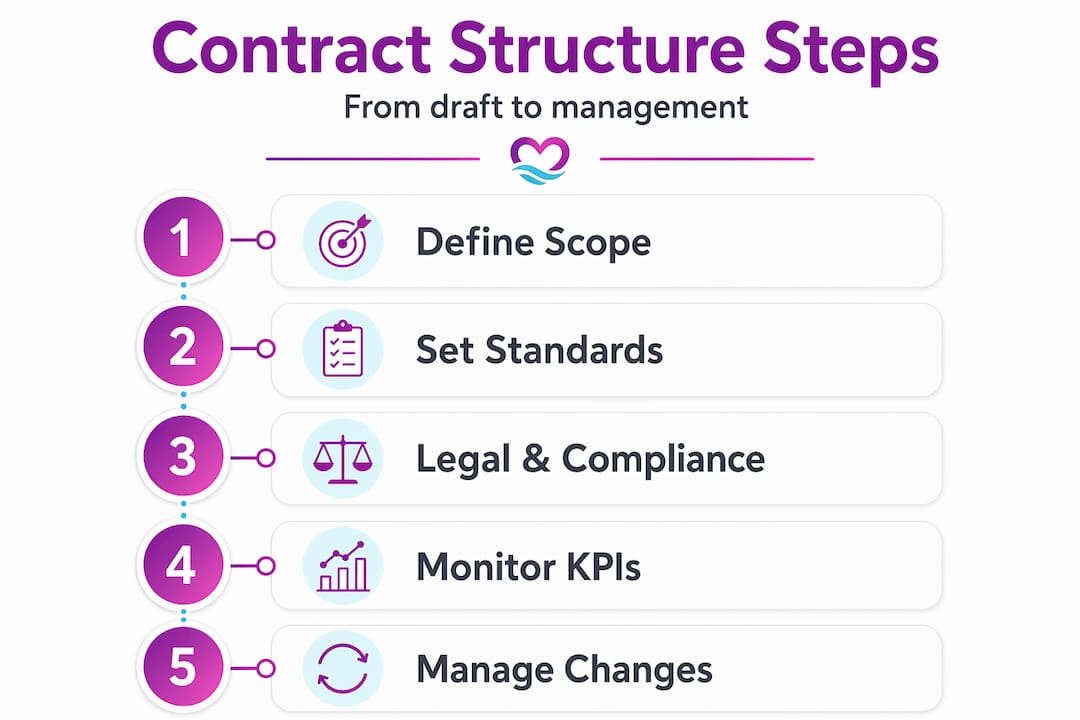
KPIs and regular facility audits with clear scorecards enable objective performance monitoring. The most effective approach combines scheduled inspections with collaborative walkthroughs where both client and contractor assess results together. This avoids the adversarial dynamic of “gotcha” inspections and creates a shared record.
The table below shows the difference between a reactive and a proactive contract structure for performance management.
| Element | Reactive contract | Proactive contract |
|---|---|---|
| Quality measurement | Complaints only | KPIs with defined pass scores |
| Inspection process | Ad hoc, client-initiated | Scheduled walkthroughs, joint sign-off |
| Complaint resolution | Informal discussion | Defined steps with timescales |
| Service credits | None | Credited against next invoice |
| Change control | Verbal agreement | Written amendment, signed by both parties |
| Annual rate review | Unspecified | Agreed in advance with CPI linkage |
Change control is often the weakest area in cleaning contracts. Frequency changes, new site additions, or seasonal deep cleans should all go through a formal written amendment process. Without this, you either end up in disputes over what was agreed or paying for changes that were never properly signed off.
Supervisor sign-off processes in multi-site contracts are particularly important. When a supervisor changes, gaps in documentation can emerge and give either party room to dispute what work was completed. The contract should specify who is authorised to sign off completed work at each location.
Pro Tip: Keep a dedicated contract records folder with signed copies of the original agreement, all amendments, every out-of-scope approval, and inspection sign-off sheets. If a dispute arises, the party with the better records almost always wins.
Notice periods and termination for convenience deserve attention too. A 30-day notice clause may seem appealing for flexibility, but it also means your contractor can leave with very little warning. A 60 to 90 day period is more practical for most commercial arrangements, giving you time to procure a replacement without a gap in service.
My perspective on what contracts actually get wrong
I have seen more cleaning disputes than most people would expect, and the pattern is remarkably consistent. The contract looked complete. It had all the right sections. But the scope of work was vague, the change approval process was missing, and the insurance clause was a single line with no coverage minimums specified.
The uncomfortable truth is that many cleaning service agreements are built on templates that have never been tested in a real operational environment. They look professional on paper but fall apart the moment a disagreement arises. In my experience, the contracts that actually work are the ones written with the specific premises, cleaning requirements, and risk profile of that client in mind.
Scope is where most contracts fail. Not because business owners are careless, but because nobody wants to write an exhaustive list of tasks and exclusions when a handshake and a broad description feels sufficient. It never is. The same goes for worker classification. Labelling someone an independent contractor and paying them accordingly does not make that status legally secure if the actual working relationship looks more like employment. Align your contract language to operational reality, not the outcome you prefer.
My honest recommendation is to invest two hours getting the scope and legal sections right at the start. You will spend far less time managing the relationship over the following twelve months, and far less money if something goes wrong.
— Kate
Work with a contractor who gets this right
If reading this has made you realise your current cleaning agreement is missing some of these elements, you are not alone. Most businesses only discover the gaps when something goes wrong.

Sealightshine builds all of this into every client relationship. From clearly defined scope of work and transparent pricing to proper insurance documentation and quality monitoring, the contracts and processes are designed to protect you and deliver consistent results. Whether you need commercial cleaning in Ipswich, a structured office cleaning service, or a one-off deep clean before a new tenancy or major inspection, Sealightshine provides the reliability and operational clarity that loose agreements cannot. Get in touch to discuss your requirements and receive a properly structured service proposal.
FAQ
What are the key elements of a cleaning contract?
A cleaning contract should include the parties and premises, a detailed scope of work with tasks and frequency, scheduling and access terms, pricing and payment conditions, quality standards, insurance requirements, and termination clauses. The scope of work is the most enforceable and commercially important section.
How long should a cleaning contract term be?
Most commercial cleaning contracts run for 12 months with an option to renew. Notice periods of 30 to 90 days for termination are standard, with immediate termination rights reserved for serious breaches or safety failures.
How do you prevent scope creep in a cleaning contract?
Attach a scope worksheet to the contract listing both included and excluded tasks. Require written approval and client sign-off before any out-of-scope work begins, and pre-agree a billing rate for extras, typically 1.25 to 1.5 times the standard rate.
What insurance should a cleaning contractor hold?
Cleaning contractors should carry general liability insurance at a minimum of £1 million per occurrence, workers’ compensation cover if they employ staff, and umbrella policies for higher-risk sites. Your contract should require insurance certificates before work commences and name you as an additional insured.
Does calling someone an independent contractor make them one legally?
No. Contractor status depends on the actual working relationship, not the label in a contract. Factors such as control over how work is done, financial dependence, and substitution rights determine classification for tax and employment law purposes.